http://la.indymedia.org/news/2012/07/254310.php
I don't usually do these opinion-type pieces, but I'm trying something a little different here. Bear with me.
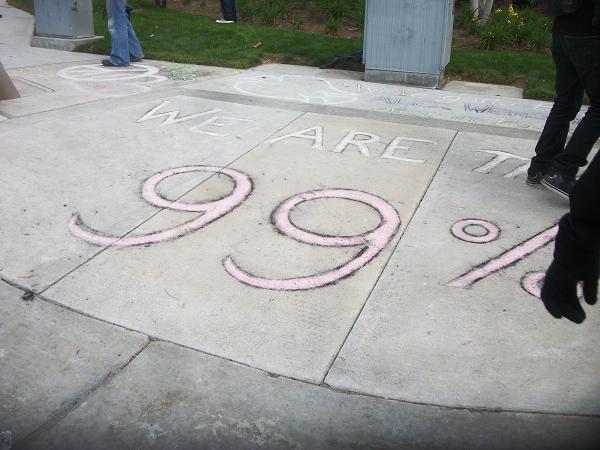
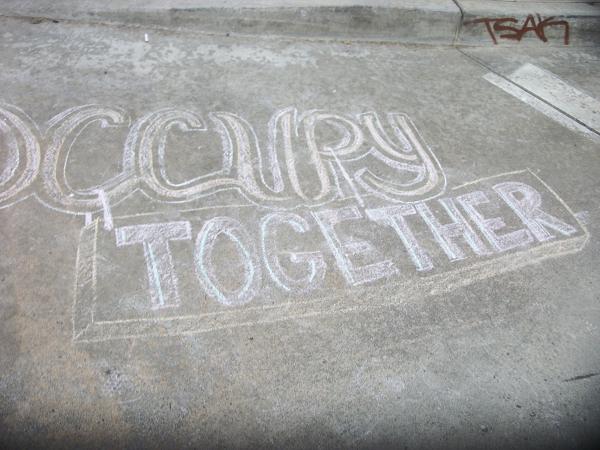
I feel like I need to write a little to give some context to the Occupy LA's ChalkWalk action of Thursday night due to the inaccuracies rampant in the corporate media.
While some journalists actually talked to Occupy and got some background on the CCA and how the chalk action grew out of it, most of them got things horribly wrong when it came to describing who did what at Artwalk.
Just to be clear, I wasn't present, but the next night at Fort Manning (the camp set up at the courthouse to demand the freedom of political prisoner and accused whistleblower Private Manning) I talked to many participants of Chalk Walk. I have also reviewed the video evidence and have been following the movement closely.
The first arrest of the evening was indeed of an occupier for chalking on the sidewalk. Video is available here:
http://www.youtube.com/watch?v=csdK83r76Po
So is the second:
http://www.youtube.com/watch?v=dLNAMF5dWgc
Subsequent skirmishes and arrests, however, primarily involved Artwalk attendees who are unaffiliated with Occupy LA.
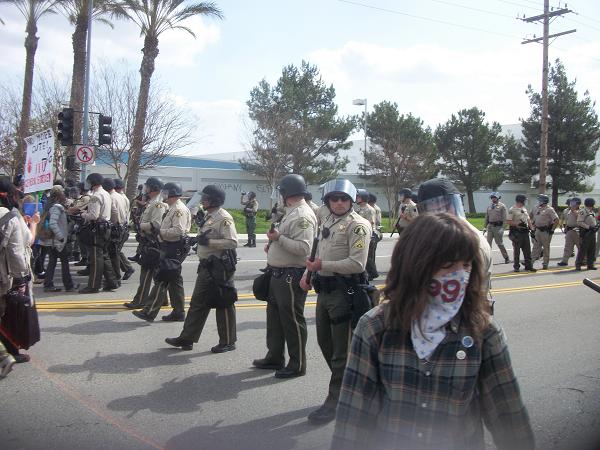
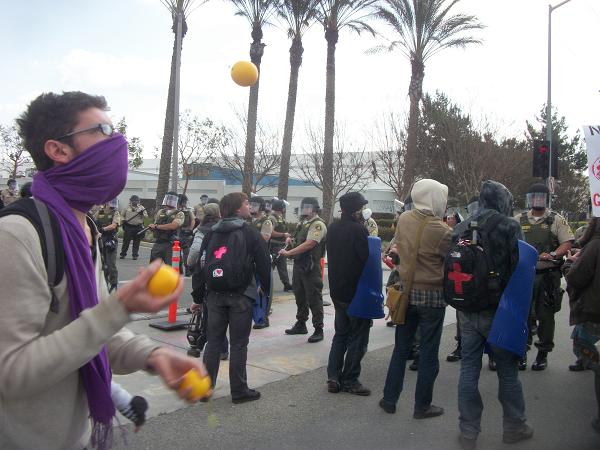
The crowd was of Artwalkers drawn by the cops in riot gear who responded to the chalking. (Nothing draws a crowd like a phalanx of riot cops.) It was Artwalk attendees who threw bottles and possibly the other projectiles claimed by media and police (although none of the videos I've seen show anyone throwing rocks).
Occupy LA yells at cops, makes fun of them, gets in their faces, and openly defies them through acts of civil disobedience, such as taking the streets and, now that they've decided it's illegal, chalking. But they do not throw things at them. The apolitical/depoliticized artwalk attendees (hipsters, artists, and homeboys, especially) are not as accustomed to interacting with police in a protest environment and had the natural reaction to witnessing such aggression: rage.
It was these folks, untempered by months of political resistance that has provoked brutal law enforcement response and trained activists in best practices, who let their anger get the best of them, not our occupiers.
Members of street defense organizations (i.e. gangs), unlike the hipsters and the artists, are used to tangling with police in confrontational situations, but homeboys also know how to fight back.
So this was the combination that brought about the volatile situation on Thursday, and brings up a couple of issues.
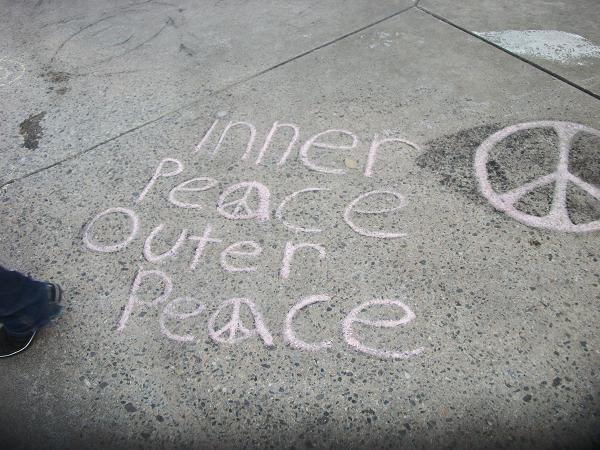
The first is one of strategy. The anti-chalking enforcement is obviously bullshit. Chalking is a harmless way to publicly express oneself and efforts to criminalize run counter to the principle of free speech that must be defended at all costs. A "chalk-in"--that is, deliberate civil disobedience of the unjust laws being cited by cops to arrest and try people if they are indeed bothering to rely on some section of code, falls directly in line with the tradition of the IWW free speech fight, lunch counter sit-ins, and even such acts as deliberately planting hemp or marijuana for political purposes. Handing out chalk and encouraging its use, in my view, was a brilliant strategy in that it created the opportunity for the civil disobedience to be highly participatory, widely expressive, and simultaneously allowed for outreach that politicizes and empowers.
However, it leads to the next issue, which is actually two issues combined: safety and responsibility. It is incumbent upon event organizers, especially when those events are political, to prioritize the safety of all participants, the unpredictability of police violence notwithstanding. That is, to the extent that it is humanly possible, participants in a political action, especially one intended to break the law, need to know what risks they are taking and what the potential consequences are. They need to be able to freely accept those risks and consequences or walk away from them as they are comfortable or able, especially as things escalate. Think about it like sex with a partner who has a right to say "no" (or use the safety word) at any time. That's practicing consent.
However, it is not clear that all Artwalk chalkers or Artwalkers who became confrontational with police knew those risks and consequences and made their decisions based on knowledge of those risks. In fact, it's pretty clear that at least some of them didn't. This is especially crucial as it concerns vulnerable individuals and communities: folks who are on probation or parole, those with prior criminal convictions, transgender folk, the young, the elderly, the disabled, and of course, the undocumented or those who could become deportable via negative contact with the law (i.e. permanent residents or folks on visas).
Just to continue on this idea, responsibility doesn't end with the action, it continues until everyone entangled is out of the clutches of the police state and its complex. Fortunately, the most conscientious of the OLA comrades are aware of this and are working very hard on the cases of the people who were caught up, and that fact deserves to be recognized.
Before I move on to conclusions, I'd like to point out a few other ways the for-profit media is fucking up. Censorship: KTLA interviewed the same vato as Sam Slovick, but neglected to show his baseball-sized welt. If you're gonna interview the guy that got shot, wouldn't you think you'd mention it and show visual evidence? In all likelihood that was the reporter's intent but these decisions are made at the editorial level, not by the face in front of the camera.
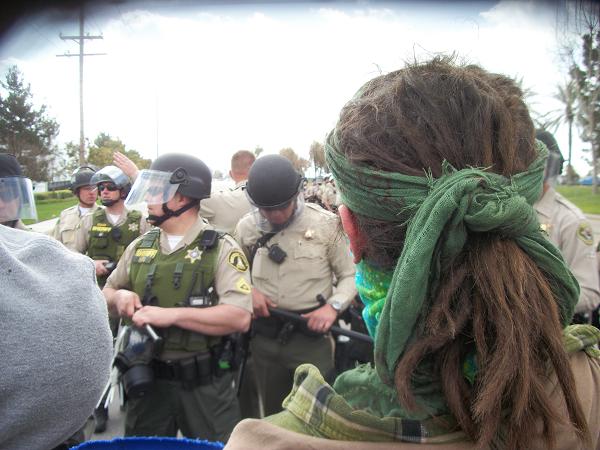
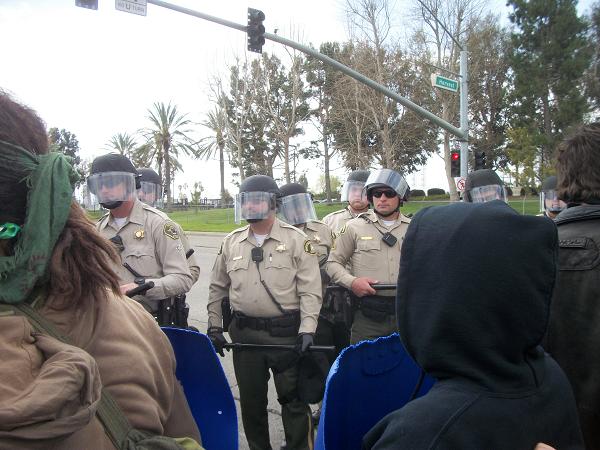
And this last one is pretty silly, but worth mentioning. The photo gallery on the LA Times website has some decent images, but is sorely lacking in accuracy and context. For example, the caption on the photo of the march to Fort Manning Friday night says that the march was in response to the police action. Wrong! That march for Manning had been planned for weeks prior to the Chalk Walk, and was about Pvt. Manning, even of some of the anger about the chalk was still palpable. The photographer (or the captioner?) also fucks up by calling the rubber bullet rifles "non-lethal." Wrong again. Those shits can kill. And finally, on a lighter note, at least one of those pics highlights the fact that it was amateur night. All of us have photos of ourselves standing in front of a row of riot cops (or with them behind us) because we participate in the struggles that bring on the repression. But one of the LA Times pics (and a YouTube video) demonstrate that for most of those people, this was the first time they had ever seen it, and they were snapping up the chance at the "romantic" or "funny" photo op.
Let's move on to conclusions. I contend that the evaluation of this action depends on the outcome, which has yet to be seen. We're already starting to see some of it on both sides, from the anti-Occupy that always crops up everywhere, en masse, usually from the corporate sector and the rightwing commentators (and I'm including those assholes like Randy Treadway who just make stupid comments from their facebook pages on the LA Times comment section and this Robert Vogel motherfucker on YouTube who don't know the shit he's talking about--you seen that?) to the pro-Occupy gallery owner who, post Chalk Walk, realized that "[t]he government is treated [sic] people like dirt and is suppressing our basic rights to be heard." This is the battle of public opinion, and it's still being waged, so don't hesitate to get your voice out there, if not somewhere very public, then at least to your friends and family on your facebook. What you say will influence how they think about it. (On second thought, some of you should probably remain silent.)
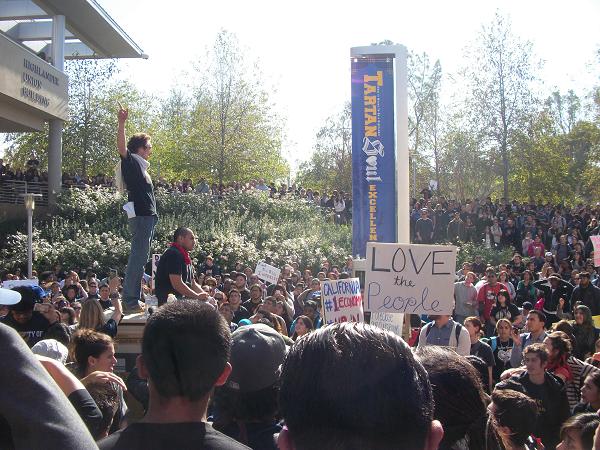
But the battle of public opinion on the web is not as important as the opinions of the non-activist people that were there, and whether or not they are politicized or radicalized by their experience. It only takes one good police riot to catalyze a "normal" person into somebody who not only realizes that shit-is-fucked-up-and-bullshit, but who is also willing to do something about it. 'Til then, the jury's out!
While some journalists actually talked to Occupy and got some background on the CCA and how the chalk action grew out of it, most of them got things horribly wrong when it came to describing who did what at Artwalk.
Just to be clear, I wasn't present, but the next night at Fort Manning (the camp set up at the courthouse to demand the freedom of political prisoner and accused whistleblower Private Manning) I talked to many participants of Chalk Walk. I have also reviewed the video evidence and have been following the movement closely.
The first arrest of the evening was indeed of an occupier for chalking on the sidewalk. Video is available here:
http://www.youtube.com/watch?v=csdK83r76Po
So is the second:
http://www.youtube.com/watch?v=dLNAMF5dWgc
Subsequent skirmishes and arrests, however, primarily involved Artwalk attendees who are unaffiliated with Occupy LA.
The crowd was of Artwalkers drawn by the cops in riot gear who responded to the chalking. (Nothing draws a crowd like a phalanx of riot cops.) It was Artwalk attendees who threw bottles and possibly the other projectiles claimed by media and police (although none of the videos I've seen show anyone throwing rocks).
Occupy LA yells at cops, makes fun of them, gets in their faces, and openly defies them through acts of civil disobedience, such as taking the streets and, now that they've decided it's illegal, chalking. But they do not throw things at them. The apolitical/depoliticized artwalk attendees (hipsters, artists, and homeboys, especially) are not as accustomed to interacting with police in a protest environment and had the natural reaction to witnessing such aggression: rage.
It was these folks, untempered by months of political resistance that has provoked brutal law enforcement response and trained activists in best practices, who let their anger get the best of them, not our occupiers.
Members of street defense organizations (i.e. gangs), unlike the hipsters and the artists, are used to tangling with police in confrontational situations, but homeboys also know how to fight back.
So this was the combination that brought about the volatile situation on Thursday, and brings up a couple of issues.
The first is one of strategy. The anti-chalking enforcement is obviously bullshit. Chalking is a harmless way to publicly express oneself and efforts to criminalize run counter to the principle of free speech that must be defended at all costs. A "chalk-in"--that is, deliberate civil disobedience of the unjust laws being cited by cops to arrest and try people if they are indeed bothering to rely on some section of code, falls directly in line with the tradition of the IWW free speech fight, lunch counter sit-ins, and even such acts as deliberately planting hemp or marijuana for political purposes. Handing out chalk and encouraging its use, in my view, was a brilliant strategy in that it created the opportunity for the civil disobedience to be highly participatory, widely expressive, and simultaneously allowed for outreach that politicizes and empowers.
However, it leads to the next issue, which is actually two issues combined: safety and responsibility. It is incumbent upon event organizers, especially when those events are political, to prioritize the safety of all participants, the unpredictability of police violence notwithstanding. That is, to the extent that it is humanly possible, participants in a political action, especially one intended to break the law, need to know what risks they are taking and what the potential consequences are. They need to be able to freely accept those risks and consequences or walk away from them as they are comfortable or able, especially as things escalate. Think about it like sex with a partner who has a right to say "no" (or use the safety word) at any time. That's practicing consent.
However, it is not clear that all Artwalk chalkers or Artwalkers who became confrontational with police knew those risks and consequences and made their decisions based on knowledge of those risks. In fact, it's pretty clear that at least some of them didn't. This is especially crucial as it concerns vulnerable individuals and communities: folks who are on probation or parole, those with prior criminal convictions, transgender folk, the young, the elderly, the disabled, and of course, the undocumented or those who could become deportable via negative contact with the law (i.e. permanent residents or folks on visas).
Just to continue on this idea, responsibility doesn't end with the action, it continues until everyone entangled is out of the clutches of the police state and its complex. Fortunately, the most conscientious of the OLA comrades are aware of this and are working very hard on the cases of the people who were caught up, and that fact deserves to be recognized.
Before I move on to conclusions, I'd like to point out a few other ways the for-profit media is fucking up. Censorship: KTLA interviewed the same vato as Sam Slovick, but neglected to show his baseball-sized welt. If you're gonna interview the guy that got shot, wouldn't you think you'd mention it and show visual evidence? In all likelihood that was the reporter's intent but these decisions are made at the editorial level, not by the face in front of the camera.
And this last one is pretty silly, but worth mentioning. The photo gallery on the LA Times website has some decent images, but is sorely lacking in accuracy and context. For example, the caption on the photo of the march to Fort Manning Friday night says that the march was in response to the police action. Wrong! That march for Manning had been planned for weeks prior to the Chalk Walk, and was about Pvt. Manning, even of some of the anger about the chalk was still palpable. The photographer (or the captioner?) also fucks up by calling the rubber bullet rifles "non-lethal." Wrong again. Those shits can kill. And finally, on a lighter note, at least one of those pics highlights the fact that it was amateur night. All of us have photos of ourselves standing in front of a row of riot cops (or with them behind us) because we participate in the struggles that bring on the repression. But one of the LA Times pics (and a YouTube video) demonstrate that for most of those people, this was the first time they had ever seen it, and they were snapping up the chance at the "romantic" or "funny" photo op.
Let's move on to conclusions. I contend that the evaluation of this action depends on the outcome, which has yet to be seen. We're already starting to see some of it on both sides, from the anti-Occupy that always crops up everywhere, en masse, usually from the corporate sector and the rightwing commentators (and I'm including those assholes like Randy Treadway who just make stupid comments from their facebook pages on the LA Times comment section and this Robert Vogel motherfucker on YouTube who don't know the shit he's talking about--you seen that?) to the pro-Occupy gallery owner who, post Chalk Walk, realized that "[t]he government is treated [sic] people like dirt and is suppressing our basic rights to be heard." This is the battle of public opinion, and it's still being waged, so don't hesitate to get your voice out there, if not somewhere very public, then at least to your friends and family on your facebook. What you say will influence how they think about it. (On second thought, some of you should probably remain silent.)
But the battle of public opinion on the web is not as important as the opinions of the non-activist people that were there, and whether or not they are politicized or radicalized by their experience. It only takes one good police riot to catalyze a "normal" person into somebody who not only realizes that shit-is-fucked-up-and-bullshit, but who is also willing to do something about it. 'Til then, the jury's out!