Showing posts with label Occupy Riverside. Show all posts

Tuesday, September 4, 2012

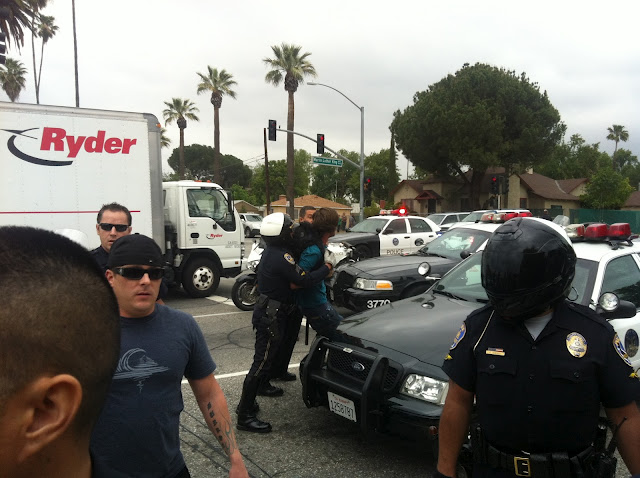
Police arrest copwatcher during checkpoint, Occupy Riverside responds

http://la.indymedia.org/news/2012/05/253374.php


Friday, May 18, 2012 

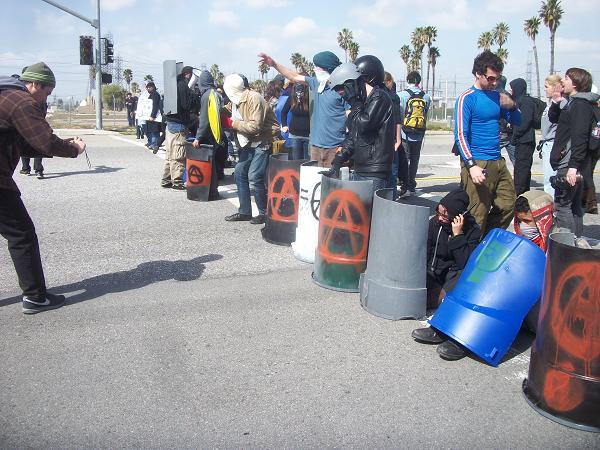
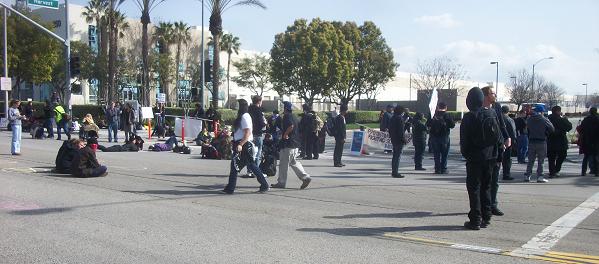
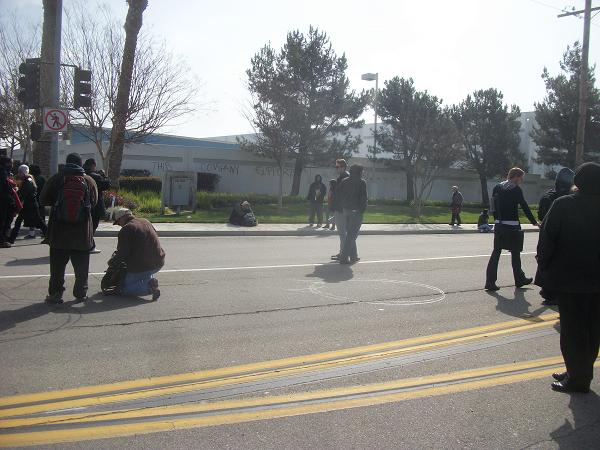
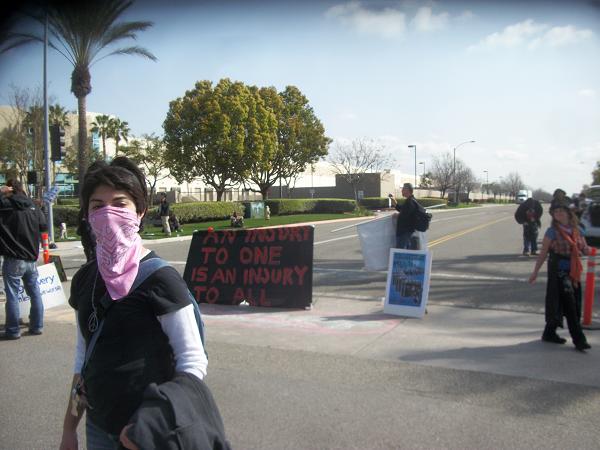
RIVERSIDE (California) - Police arrested a woman for observing a checkpoint Friday evening. The community responded in protest, occupying the area in front of Robert Presley Detention Center overnight, marching, and demanding the release of our comrade. The woman was released to the hospital at approximately eight o'clock Saturday morning, despite having suffered an epileptic seizure some nine hours earlier.
Police arrest copwat...
Friday turned out to be a long day for many occupiers and their allies. Some had attended the Labor Studies Conference at UCR, and quite a number were also at the Bank of America protest in the afternoon. Even those who weren't were at the earlier events had planned on attending a nuclear power-themed general assembly and a strategies session. But plans changed when activists spotted the downtown police roadblock on northbound Market Avenue.

Immediately, people showed up with signs to warn approaching drivers and cameras to document any abuses or police incidents. The operation's commander was notified that observation and documentation was going to be taking place at a distance.

Monitors stood on the sidewalk in between the street where the checkpoint was taking place in and the parking lot that served as both staging area and secondary inspection area.

Northbound motorists in both lanes were stopped and demanded their driver's licenses. Some were asked if they had had anything to drink. Many were directed into the parking lot, where many families were removed from vehicles and numerous vehicles were towed.

At about 7:30, an officer approached the group of about six copwatchers, one of whom was filming, and ordered them to leave. The man who was filming asked if he was breaking a law, and if so, which one. The officer responded that it was a matter of officer safety and that he couldn't conduct the checkpoint and "keep an eye on" the activists at the same time. When the man repeated the question, the officer said that he wasn't gonig to answer any more questions, and that if the group did not remove itself in five seconds, they would be arrested. He called for backup and started moving in on the man, who backed up quickly, and the group began to leave. One of the group, a 22-year old woman and a student at Riverside Community College, was arrested.

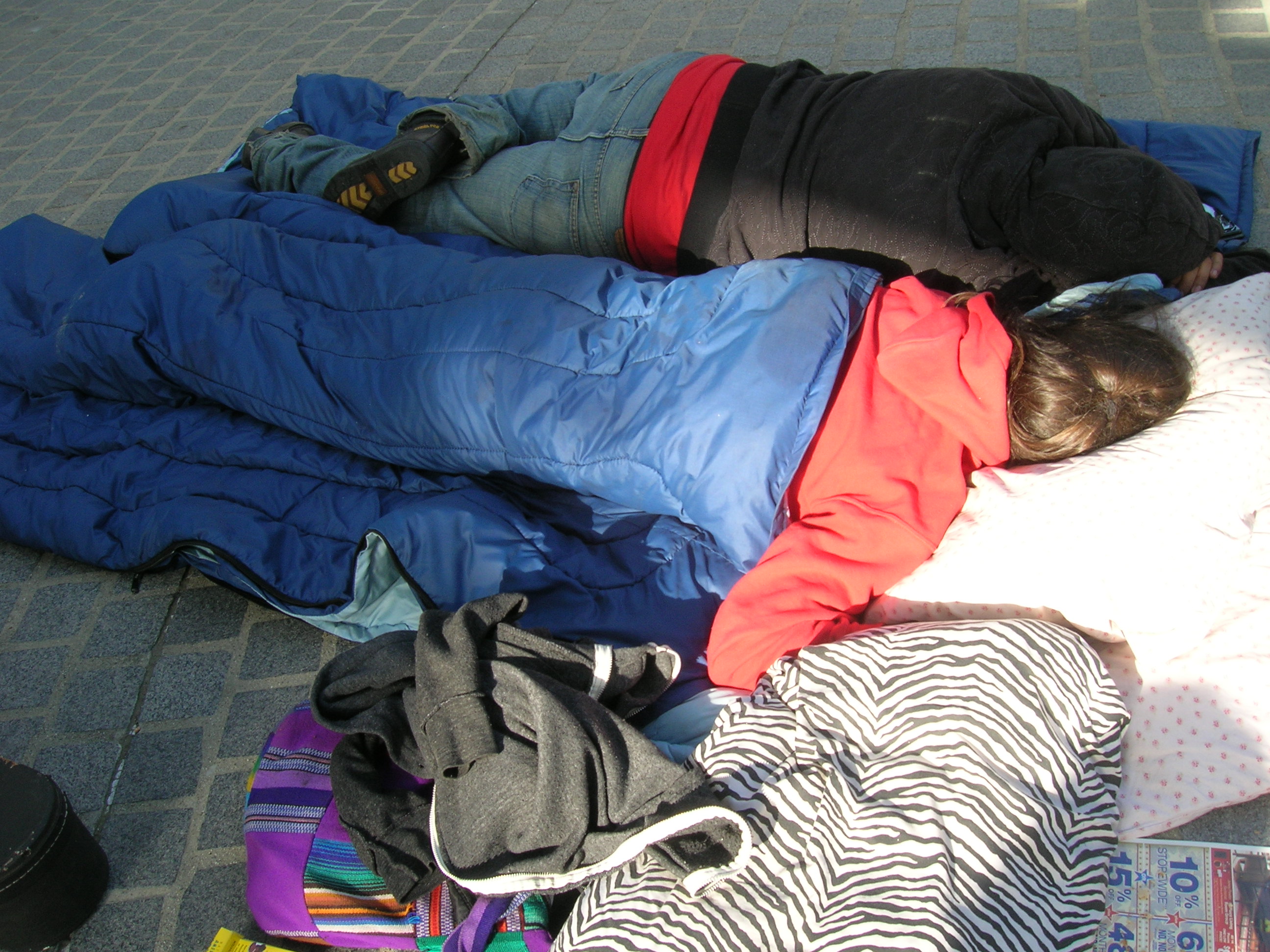
The activists were unnerved and at that point the observation action turned into a protest of the arrest. Over the next two hours, numerous supporters arrived to the location to join the protest. A meeting was called and a decision made to wait outside the jail and protest the arrest. When it became clear that she would not be out until the morning, we retrieved our pillows and blankets and set up camp for the night.

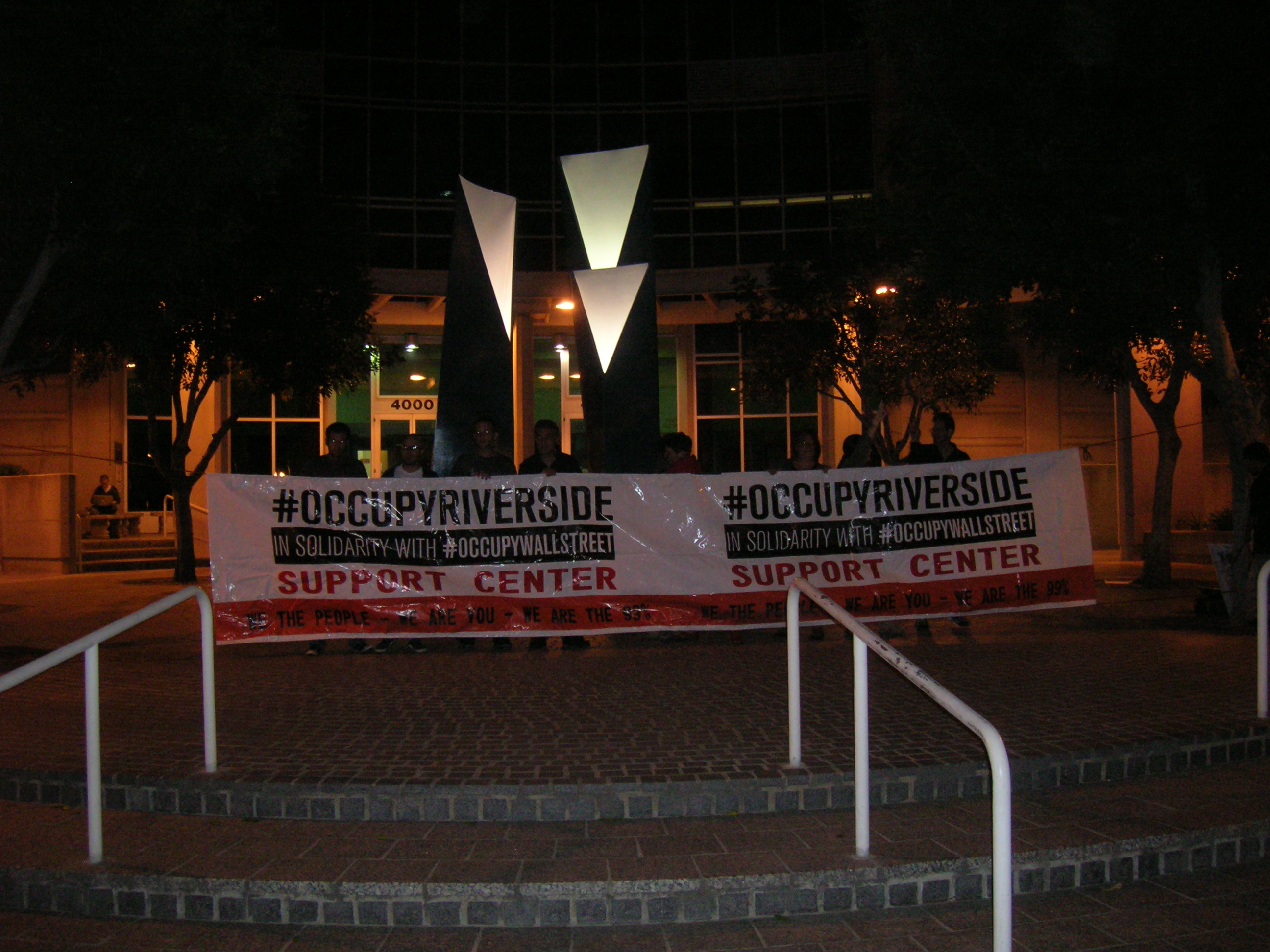
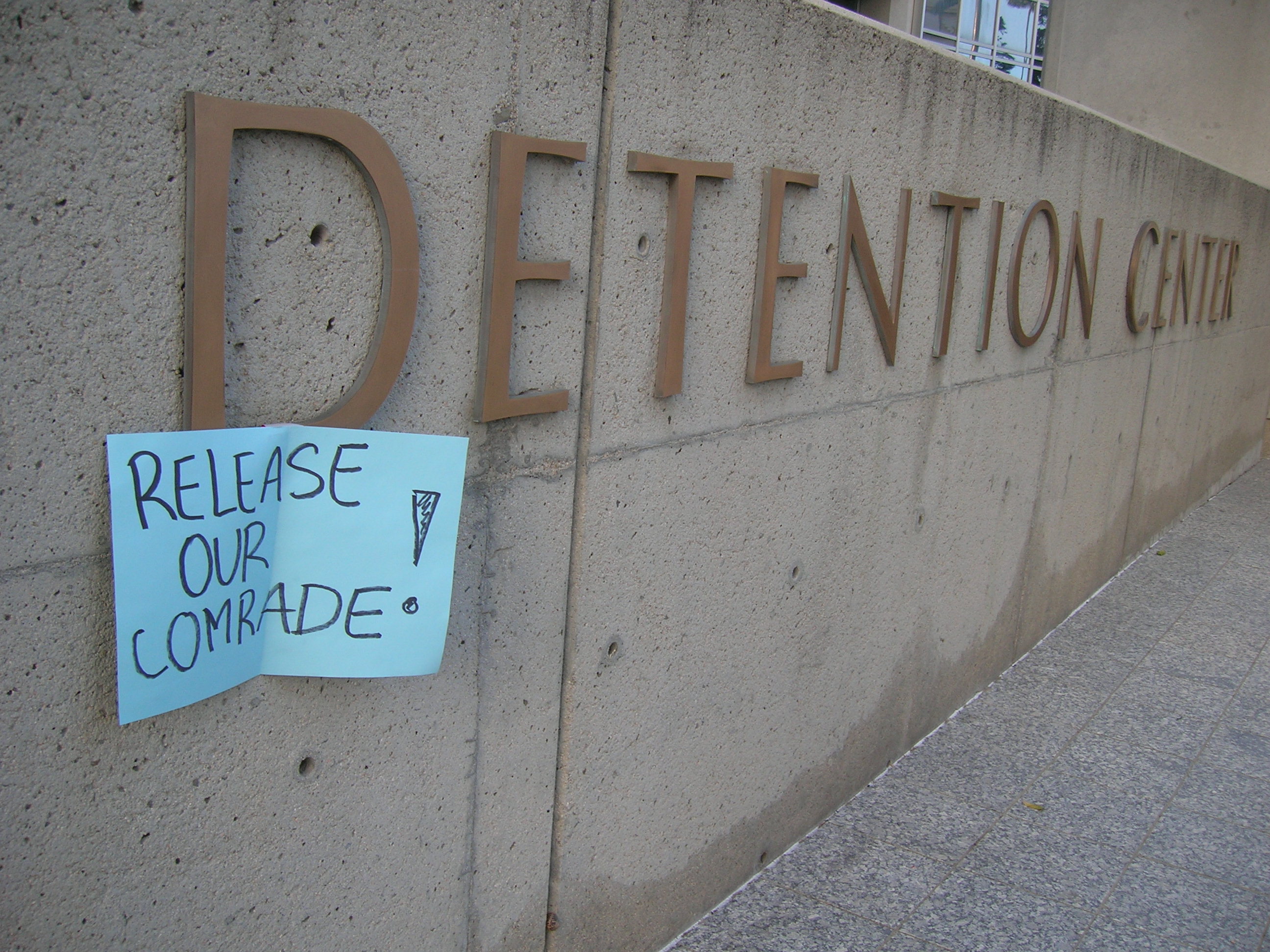
The area was scrawled with chalked messages of and solidarity and others that read "ftp." Signs were placed in the trees and on walls surrounding the detention center. The Occupy Riverside banner was placed on the steps of the detention center, and when deputies ordered its removal, an even larger one was tied it between two trees in front of the sheriff's door. This, too, was ordered down, under allegations that it was a safety hazard because "someone might not see" the 20-foot banner. Unfazed, the occupiers tied the banner between the poles holding the city streetlights.

As people exited the jail, they were surprised to see the number of people but were encouraged that we were out there. They were not surprised to learn of the injustice committed by the police, and several shared stories of abuse by police and sheriffs in the detention center. Many also joined us, opting to show their solidarity for our sister and with our efforts against the system.

To pass the time, we chanted, sang, and read together. We took time to get to know the new people who had joined us. We made signs and banners. We ate and drank coffee and smoked cigarettes.

At about seven in the morning, we saw an ambulance pull into the back of the jail. Concerned for the safety of our friend and aware of her medical condition, we rushed inside, only to learn that the desk clerk had no information. Two hours later, an official came out and informed us that the accused had been transferred to the county hospital in Moreno Valley. We rushed over there and were eventually able to visit her.

She was discharged at about noon.

Once we were able to speak to hear, we learned what had happened. Authorities had attempted to pump her for information, but were thwarted when she asserted her right to not speak. They made snide comments about Occupy and the protest. They needlessly seized her footwear. They ignored her cries for help when she tried to alert them to her feeling the seizure coming on, mocking her instead. Hours later, once she woke, they did not acknowledge the episode, just asked if she was cold but did not provide any blanket after an affirmative response. It was only after the second seizure, at about six in the morning, that medical attention was provided and she was transported, still in chains, to the hospital.

The general assembly that night was particularly well-attended, with the many new and relapsed occupiers in attendance joined by released detainees, visitors from Sacramento and San Diego occupys, and passersby.

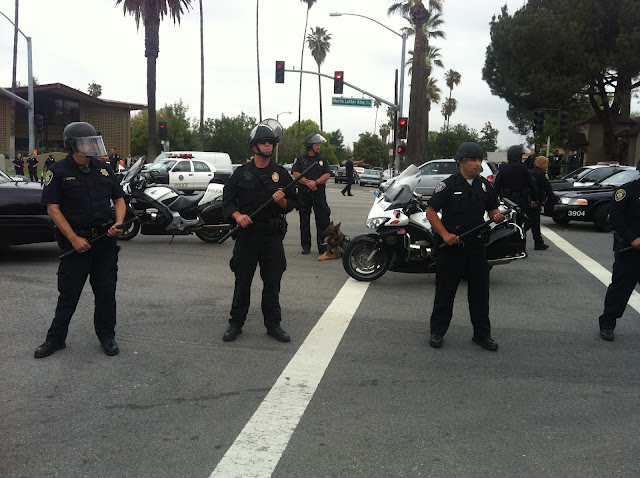
Right after GA a militant march took place that immediately took the streets, blocking traffic and parading discontent throughout the downtown area. As it descended on the jail, three police squad cars arrived but were confronted by the angry group that asserted its right to protest. The march stopped by the police station before joining in a group hug in the middle of the street, and then spreading the word to the elderly crowd then exiting the Fox Theater.

As we returned to People's Plaza, we passed police chief Sergio Diaz, dressed in civilian clothes and chomping a cigar, who glared angrily as we passed by chanting "No justice, no peace! No racist police!"

Ever since May first, Occupy Riverside has been in an existential crisis, wondering which way it would go in the future. But this incident reminded us that what we will do, we have done already: Form community that supports each other, feed the hungry, stand with homeowners against the banks, defend education and educate one another, take back public space and use it for democracy, and provide an alternative political body as a refuge from the 1%-dominated spheres.


002
002...

003

003...

Riverside Celebrates May Day, Police Violence Mars Protest

http://la.indymedia.org/news/2012/05/252926.php


Tuesday, May 1, 2012
RIVERSIDE (CA) - Several hundred people participated in a series of actions marking International Worker's Day in Southern California's Inland Empire. The day featured an Occupy bank protest, an immigrant rights march and rally, and a food and clothing giveaway hosted by an autonomous grouping. The day of community empowerment was temporarily disrupted, however, when police violently targeted students and arrested them.
Riverside Celebrates...
Preparations for May Day began months ago, when, shortly after Occupy Los Angeles called for a general strike, Occupy Riverside endorsed the call and began reaching out to community groups and participating with other Southern California occupy movements in the planning of build-up actions.

Occupy Riverside planned and hosted the #F29 day of non-violent direct action to shut down the corporations comprising the American Legislative Exchange Council, focusing on distribution centers used by Walmart, as a build-up action for May 1.

Outreach was also done to labor unions, organizing efforts, community groups, and immigrant rights groups. Hundreds of doors were knocked on in the Riverside area, primarily in the downtown and Eastside areas.

Other, less-traditional methods were also used, although it is not clear by whom. Capitalizing on the vast talent pool within Occupy Riverside and the larger Inland Empire community, numerous works of art were produced, distributed, and posted throughout the region. Wheatpasted and painted messages were spotted in Riverside, Corona, Ontario, Pomona, Claremont, and Chino. No particular group has claimed credit.

Another unorthodox method was used on Monday, April 30th. Students at John North High, Arlington High, And Ramona High Schools in Riverside were distributed letters claiming to be from the district superintendent announcing the cancellation of classes. In response, the district made over 100,000 automated phone calls to district households to disavow the letter and demand that students attend school, where standardized testing was scheduled to occur at many campuses. According to reports in the corporate media, the schools are "working on an investigation with Riverside police."1

Occupy Riverside also took the initiative to schedule a week of consciousness-raising events prior to May 1. The "Five days of May" spring training began on April 26, with an education fair held in People's Plaza, the site of the former Occupy Riverside camp. Workshop topics included the history of May Day, 9/11 and its political aftermath, a primer on immigration and immigrant rights, and a discussion on problems in the public education system and the need for unity between students, faculty, and staff to bring about change.

The following day featured a payday protest of Wells Fargo, calling particular attention to the bank's financing of private prison corporations and the impact the industry has on the migrant population. That action featured a march, streetcorner rally, the setting up of a tent, and a "tour" of the bank, in which OR militants entered and chanted "Invest in communities, not in jails!" before being asked to leave. Police responded as soon as the tent was set up in front of the bank (they did not seem to mind a bit while it was on the street corner) and forced its removal. Otherwise, the protest went off without incident.

On Saturday a march was scheduled to promote the Occupy Riverside-initiated May 1 gas boycott in protest of high gas prices and all the other injustices rooted in the petroleum industry, from ecological disasters like the BP oil spill to their influence over US foreign policy and the wars it creates.

Plans changed, however, when Occupy activists learned of an anti-violence rally planned by the Riverside Area Peace and Justice Alliance, and most went to join them. Some, however, spread the word about the gas and driving boycott. Occupy Riverside has found that targetting petroleum companies has been effective means of tapping into popular anger toward high gas prices.

All were small actions in comparison with Tuesday. May Day began with a noon protest of Wells Fargo, which had extra security since early in the morning. About 40 picketers shouted anti-bank slogans, and mic-checked the reasons they were opposed to the banks practices, naming the foreclosure crisis and the financing of for-profit detention centers as our primary grievances.


The ATMs were declared "out of order" and the bank was declared "shut down" for the day. We then entered the building lobby, which caused the security to enter the bank and lock the doors.


Customers were still allowed to enter, but only one at a time, and were locked in once they entered.


Occupy Riverside posted notices of closure on the banks doors and then ceremoniously exited, chanting "No private prisons!"


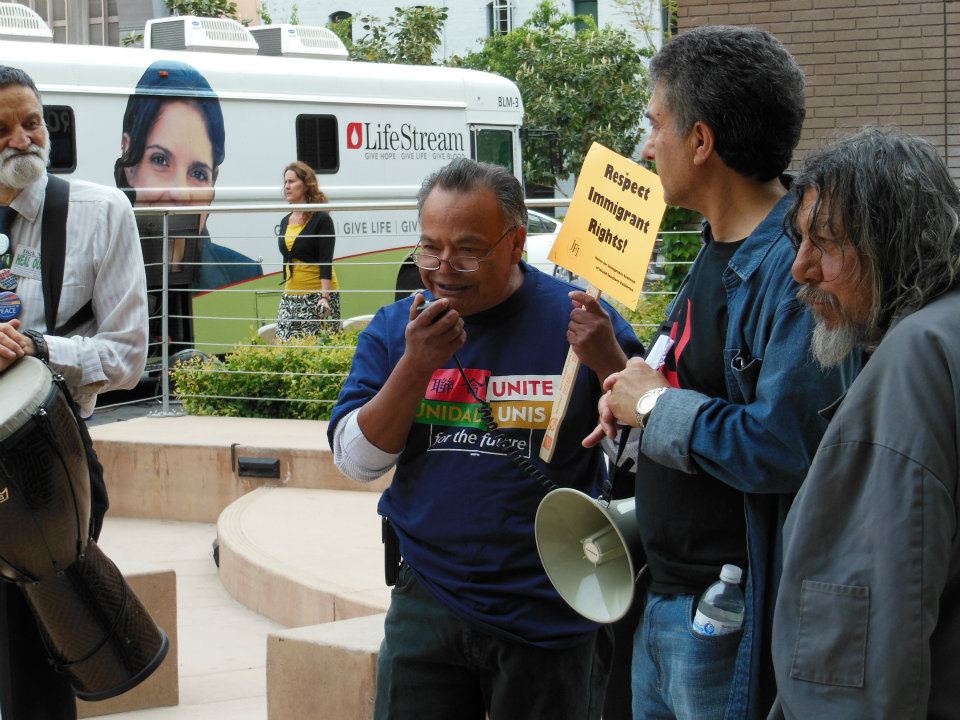
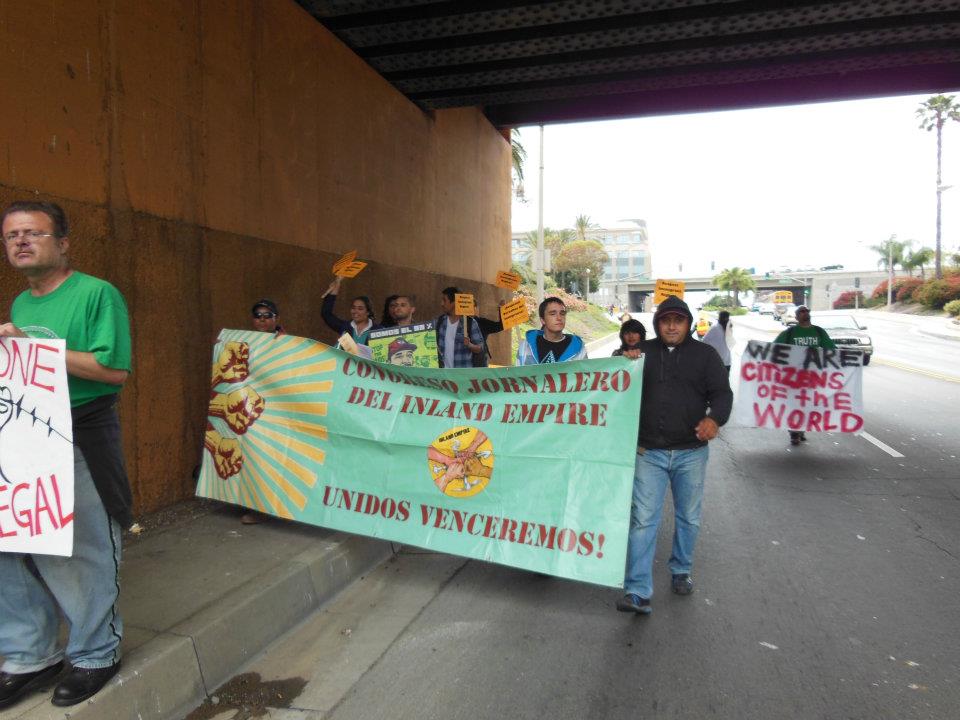
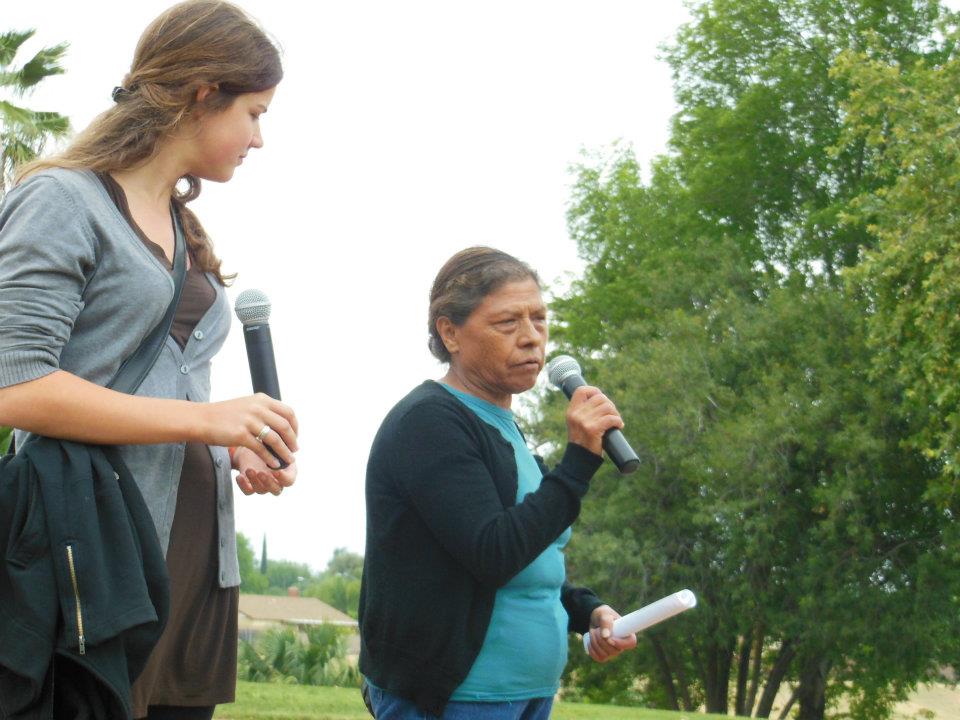
We then marched a block south to Riverside City Hall, where we joined the pre-march rally hosted by the Justice for Immigrants Coalition of Inland Southern California, a broad-based coalition of faith-based, labor, student, and community groups and activists. Speakers included people from the Inland Valley Friends, Riverside's homeless community, Occupy Hemet, as well as workers from the Pomona College dining hall and Martin Berrospe, a Rancho Cucamonga day laborer recently racially profiled and detained during ICE's "Operation Cross-Check," which purported to target "criminal aliens" for deportation in the largest ICE operation in US history. Berrospe, however, has no record and was stopped without any reasonable suspicion that he was undocumented. He was detained for 36 days but refused to waive his rights and was freed after a community campaign to raise his bond. He will be facing deportation proceedings this summer, but was on hand to express his gratitude and words of encouragement.


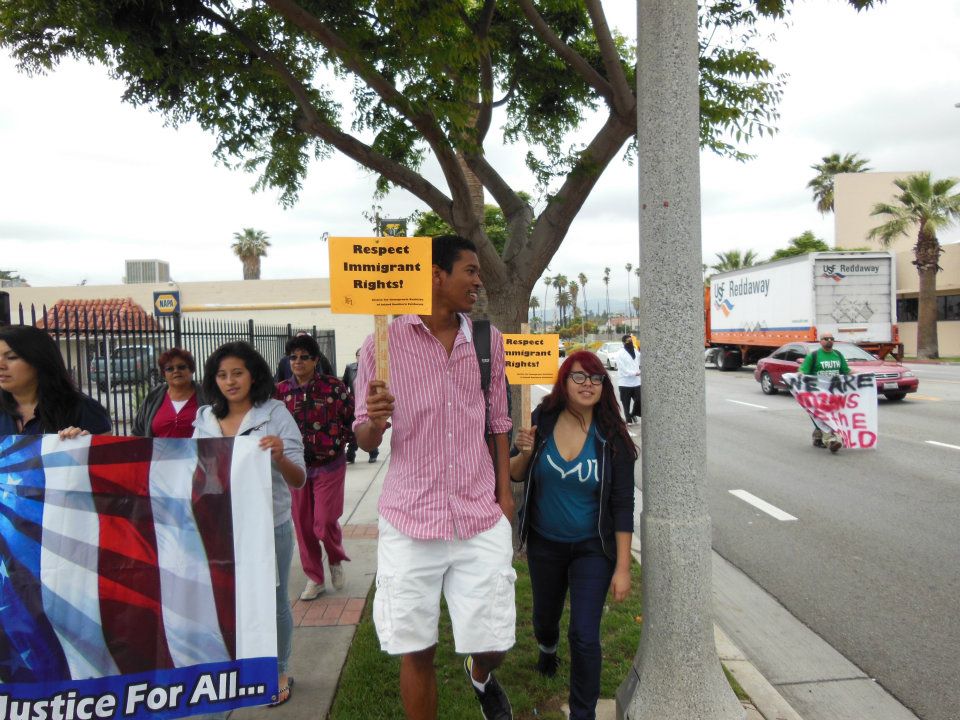
After a few speeches to energize the crowd, the hundred-plus marched through People's Plaza and down University, taking both the sidewalk and the street.


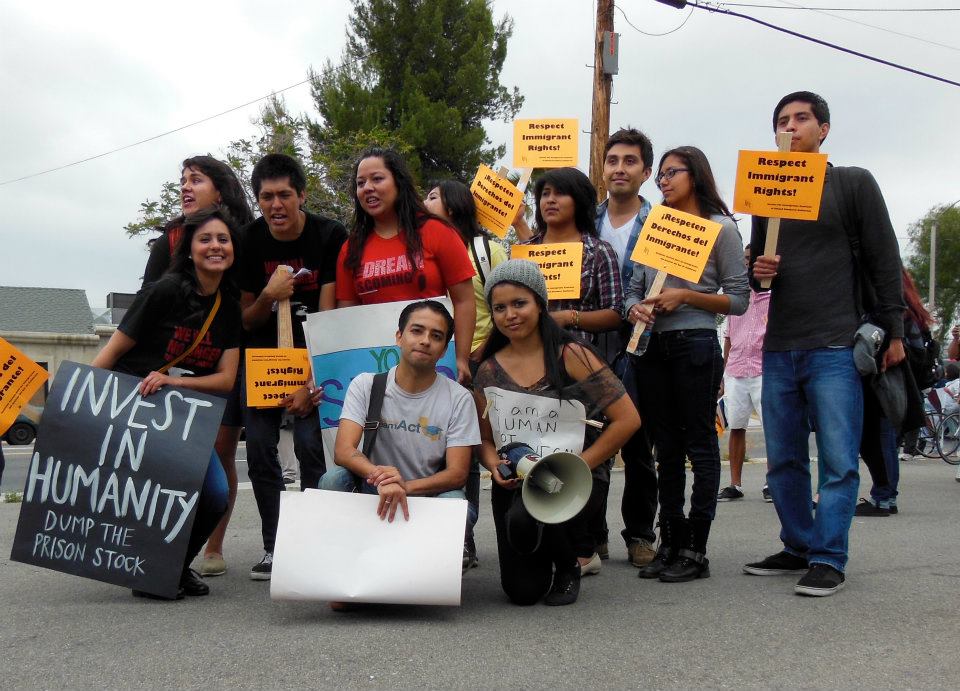
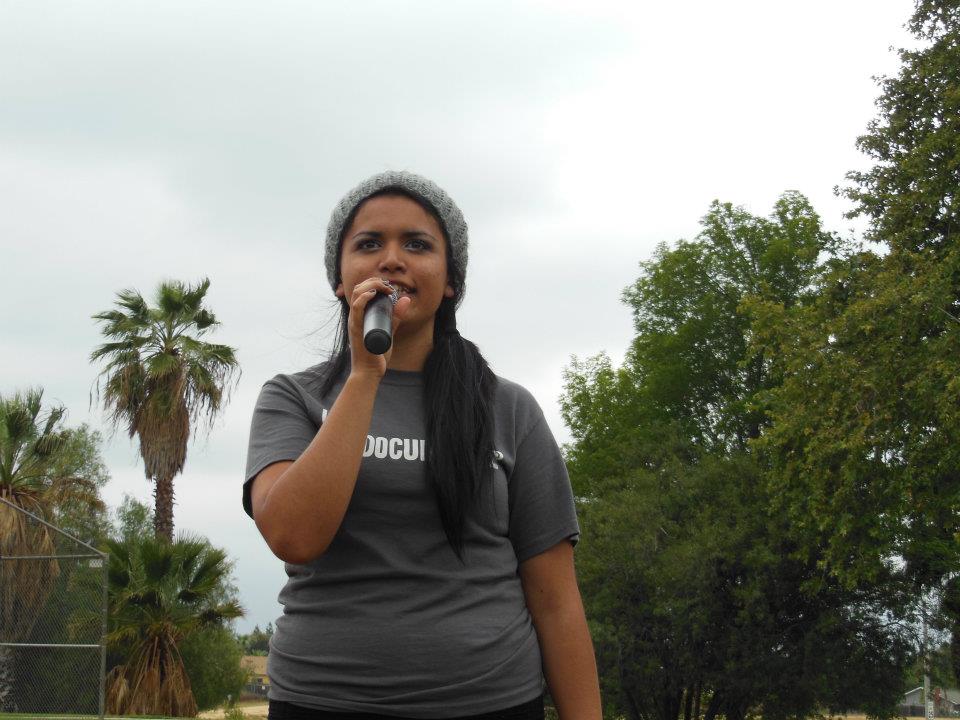
Members of the Inland Empire Immigrant Youth Coalition led chants of "Undocumented and unafraid!" and many other pro-migrant slogans.

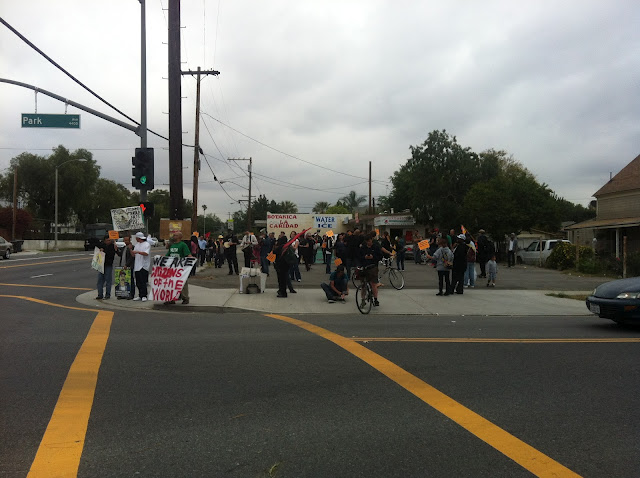
At Park Street, we turned to pass the historic Our Lady of Guadalupe Shrine, an important site for Eastside Riversiders. Faithful there distributed water to the thirsty marchers and joined the parade.

Upon arriving at the corner of 14th and Park, marchers occupied the intersection, blocking traffic for several minutes while waiting for the contingent of students from Riverside Community College to join us.


After some delay, march organizers continued the march to Bordwell Park, sensing the impatience of the crowd and certain of the safe arrival of their RCC comrades. Shortly after leaving the intersection, police began to follow the march.

Upon arriving at Bordwell Park, picnic tables full of free groceries awaited us, as did piles of clothes, furniture, and household items gathered by volunteers from Riverside's Really Really Free Market. The Occupy Riverside and Occupy UCR library was revived and many boxes of books, most of them political in nature, were distributed.

Sound systems were set up, and protesters began to settle in for the rally when screams came from the street. The crowd rushed to the intersection of Martin Luther King and Kansas to observe the police brutality occurring there. The RCC contingent had finally caught up with the main march but was attacked just prior to its arrival at the park. It is unclear why.

Witnesses reported that while some students marched on the sidewalk, those arriving on bicycle were legally riding on the street. March security guided them, but was clipped by two vehicles. In plain view of the "escorting" officer, these two vehicles came dangerously close to the march security, endangering their safety. The police did nothing to intervene in the situation.

Subsequently, according to witnesses, an officer in a vehicle ordered one of the cyclists onto the sidewalk. When the cyclist, an RCC student, questioned the order due to its illegality, the car cut off the path of the cyclist and the officer attempted to pull the student from his bicycle. The officer then kicked him and hit him with his baton.

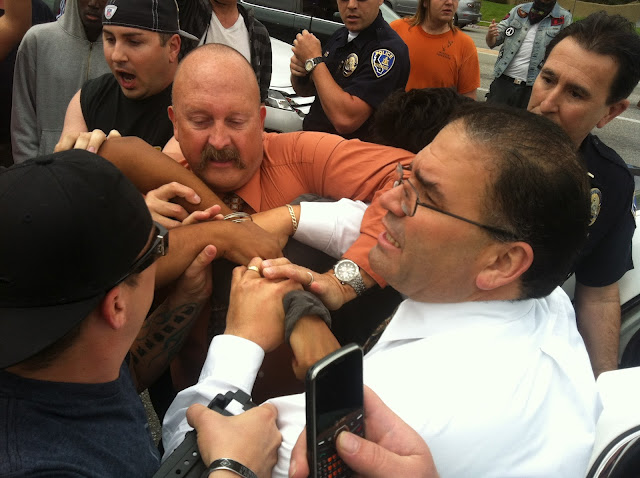
It was at this point that the cry for witnesses and cameras went up and people rushed to the corner. Within seconds, numerous police vehicles, both marked an unmarked, were on the scene. The officers scuffled with protesters, bringing out riot weapons such as rubber bullet guns and police dogs. They arrested the initial cyclist and then another young man, a UCR student, slamming him violently to the ground. According to reports in the Spanish-language media, he was also beaten while handcuffed on the ground.2


After the second arrest, the crowd returned calmly and peacefully to the park depite the growing number of armed and armored officers in the street. Once the officials realized that we were not going to allow ourselves to be provoked into using any kind of violence against them, they withdrew their forces, leaving only a few cars around the perimeter of the park within sight of the convergence.

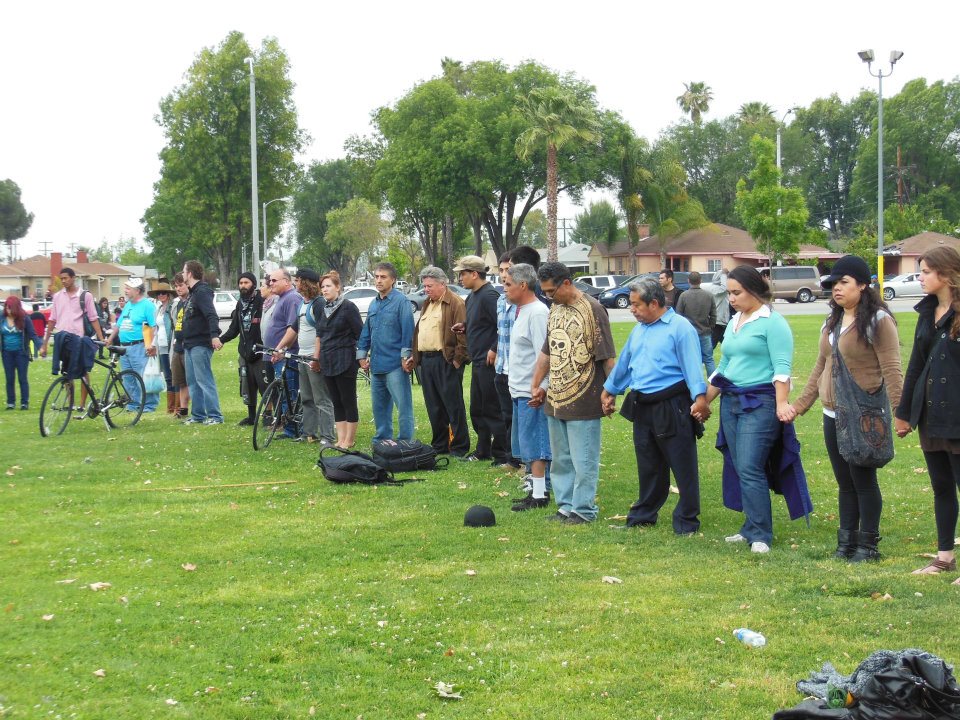
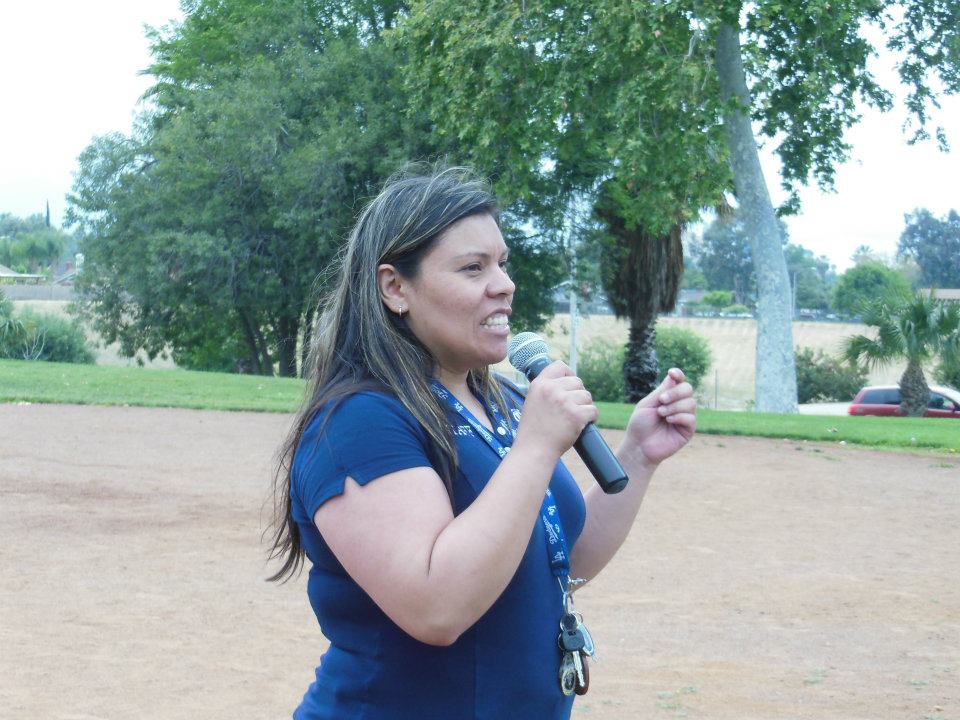
Since the crowd's nerves remained on edge, Julio Marroquin, a community activist and the founder of the Inland Empire Latino Forum within Occupy Riverside, led an ecumenical prayer denouncing the police violence and urging peace. Once we were a bit calmer, we began hearing speakers on a number of topics. Luz Gallegos of TODEC informed us about the struggle in Southern Riverside County, and Jose Calderon, professor emeritus at Pitzer College gave a brief historical retrospective in honor of Lucy Gonzales Parsons and her partner Albert, who was assassinated by the state in the wake of the 1886 Haymarket Affair in Chicago.

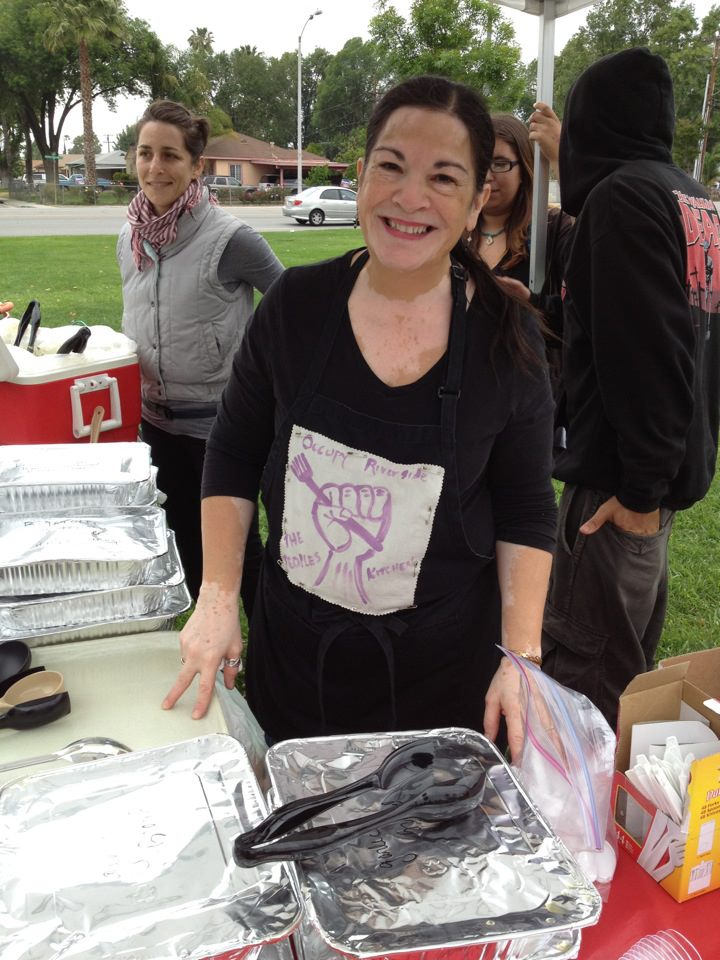
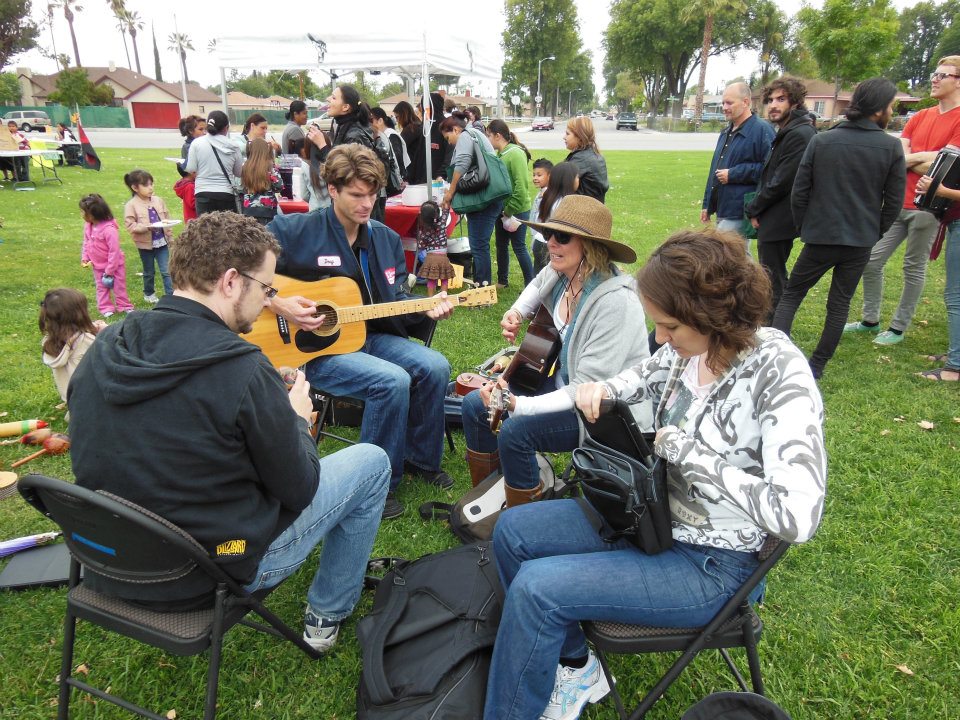
Over 200 meals were served courtesy of the People's Kitchen and community members, and meals included vegan options. A group of DREAMers joined a pickup soccer game with some Riverside occupiers, and musicians formed a circle and found expression. Others held discussion groups to digest the police repression, and much information was shared at the welcome table.

A critical mass bike ride, originally scheduled for seven p.m. at the end of the convergence, was reorganized. Rather than waiting, the cyclists decided to ride to the Robert Presley Detention Center to support the arrestees and to gather information.

While several activists and community members were quite upset about the violence and the state's attempts to shatter the unity we had created between multiple factions as well as the neighboring community, others sought to emphasize the triumphs of the movement that were embodied in the day and its events.

Activists vowed to pursue all avenues towards justice for those who were wrongly detained, as well as to continue organizing throughout the year to build community and power for oppressed people.

1. Straehley, Dana. "RIVERSIDE: Schools asks police to investigate fake May Day letter." Press-Enterprise, May 2, 2012. http://www.pe.com/local-news/riverside-county/riverside/riverside-headlines-index/20120502-riverside-schools-asks-police-to-investigate-fake-may-day-letter.ece accessed May 3, 2012.

2. Cano, Alejandro. "RIVERSIDE: Policía interviene en manifestación," La Prensa, May 1, 2012. http://www.laprensaenlinea.com/noticias/noticias-historias/20120501-riverside-policia-interviene-en-manifestacion.ece?ssimg=557859#ssStory557860 accessed May 3, 2012.

002

002...
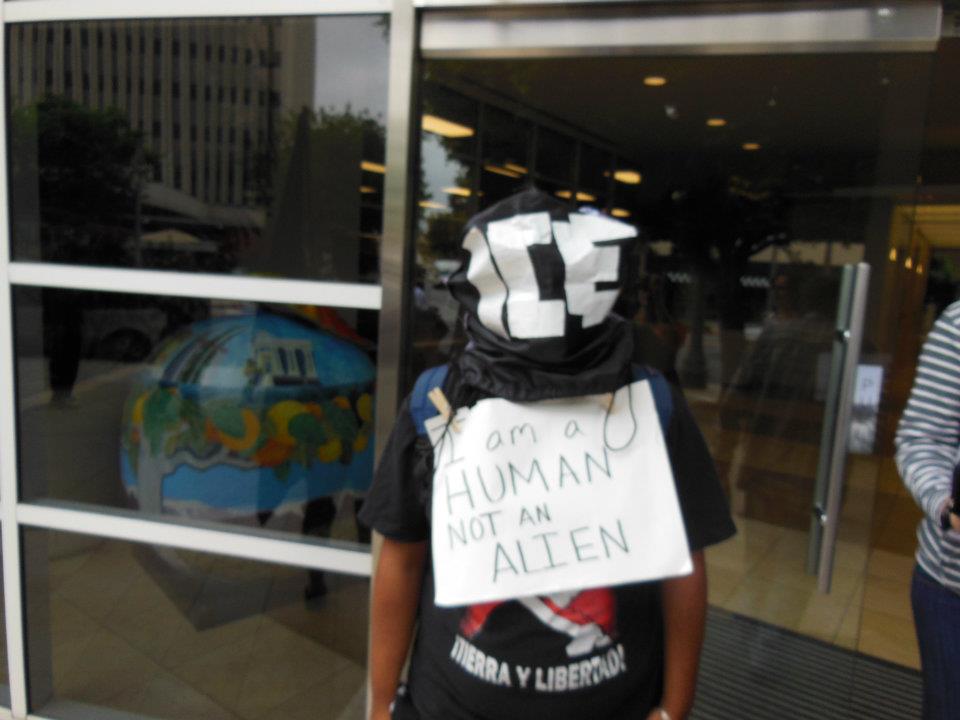
"Detainee" in ICE hood at Wells Fargo shutdown, May 1, 2012. Photo: Marina Wood

003
003...
Stealing homes is OUT OF ORDER! No Banking. Wells Fargo Makes Families Homeless. Photo: Marina Wood

004

004...
Julio Marroquin speaks at City Hall prior to the march. Photo: Marina Wood

005

005...
Jornaleros bringing up the rear. Photo: Marina Wood

006

006...
Photo: Marina Wood

007

007...
Photo: Marina Wood

008

008...
This was a touching moment. While marching down Park, a group of workers, likely jornaleros, heard us and stopped working to watch us pass. As they did, they raised their tools in the air and held them up the whole time we were passing. Photo: Marina Wood.

009

009...
After occupying the intersection, we took the parking lot. Photo: MIguel

010


010...
IE-IYC. Photo: Marina Wood.

011

011...
Second arrest. Photo: Miguel

012

012...
Lots of cops. Photo: Miguel

013

013...
Prayer. Photo: Marina Wood

014

014...
Luz Gallegos of TODEC. Photo: Marina Wood

015

015...
Maria Barragan of IE-IYC. Photo: Marina Wood

016

016...
Elisea of Workers for Justice. Photo: Marina Wood

017

017...
Annie of the People's Kitchen. Photo: Matthew Snyder

018

018...
Cookies. Photo: Matthew Snyder

019

019...
No hunger in Riverside? Photo: Matthew Snyder

020

020...
Music. Notice the accordion to the far right. Photo: Marina Wood

Friday, March 23, 2012

F29 photos

http://la.indymedia.org/news/2012/03/251969.php

by Rockero Saturday, Mar. 17, 2012 at 4:07 PM
rockero420@yahoo.com
Wednesday, February 29, 2012
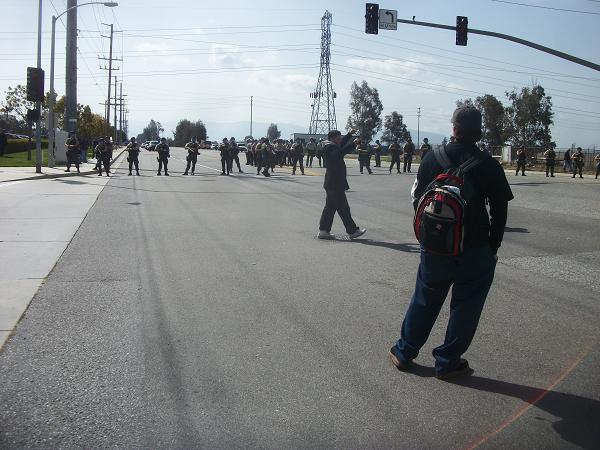
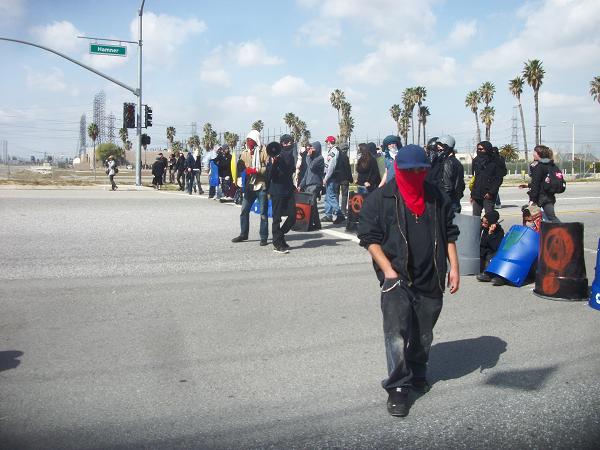
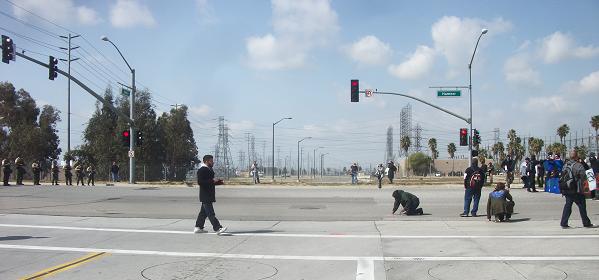
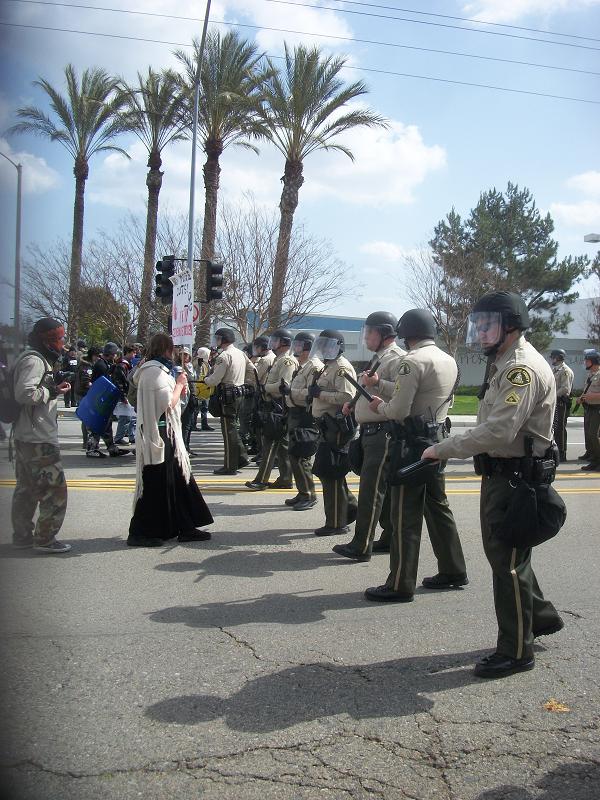
EASTVALE, California - About 300 protesters from Occupy Riverside, Occupy LA, and elsewhere shut down approximately 10 warehouses moving products for ALEC corporations. Here are some photos.
Photos from the February 29 action at the world's largest Walmart distribution center.

002

by Rockero Saturday, Mar. 17, 2012 at 4:07 PM
rockero420@yahoo.com
Band performs as cops approach

003
by Rockero Saturday, Mar. 17, 2012 at 4:07 PM
rockero420@yahoo.com
Intersection of Harvest and Hamner, Schneider warehouse in background.

004

Message on warehouse wall reads "This Company Supports Slavery"

005

IWW blocks off entrance to harvest street, where truck entrance is.

006

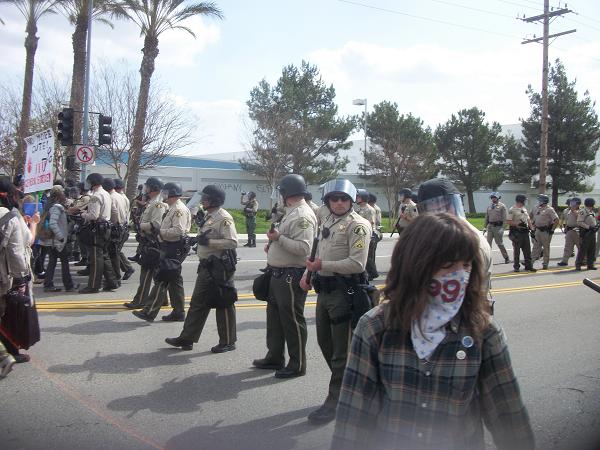
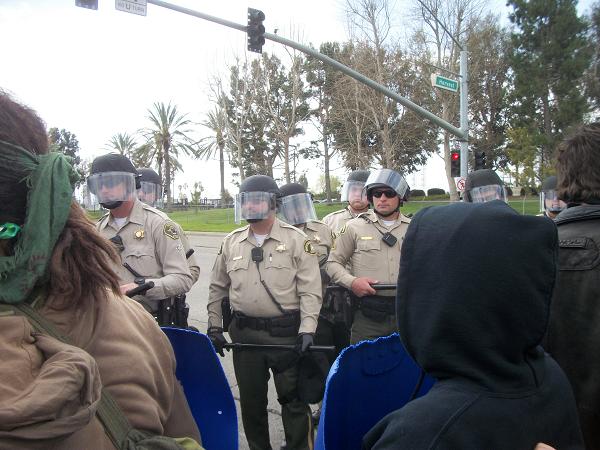
Cops line up at intersection of Hamner and Micro, where the Micro warehouse has been closed by protesters.

007

Shields line up on opposite end of intersection of Micro and Hamner.

008

Scrimmage lines

009

Cops push line of protesters back.

010

Cops push line of protesters back.

011

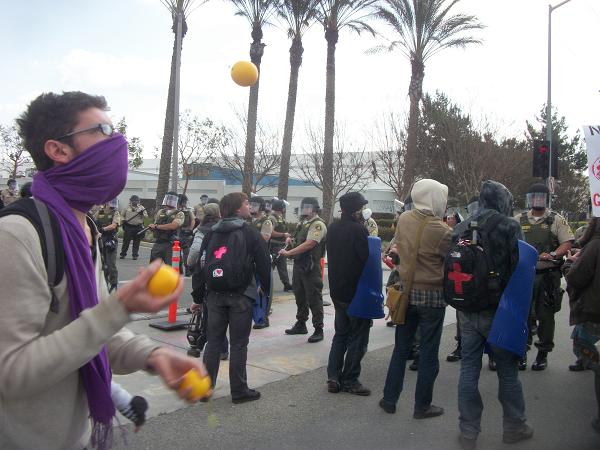
Juggling

012

by Rockero Saturday, Mar. 17, 2012 at 4:07 PM
rockero420@yahoo.com
Sign on fence reads "ALEC: Trojan Horse of the 1%"

013

by Rockero Saturday, Mar. 17, 2012 at 4:07 PM
rockero420@yahoo.com

014

015

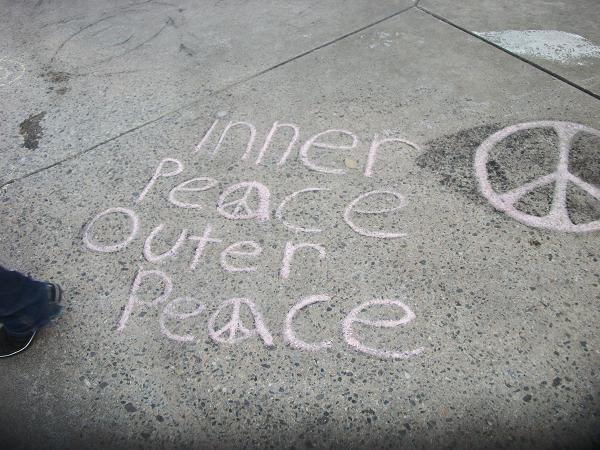
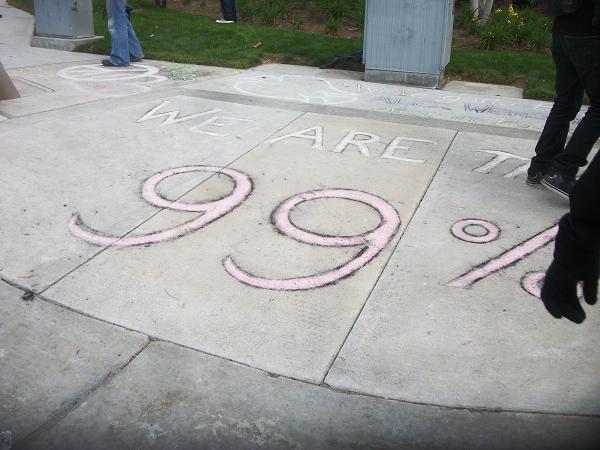
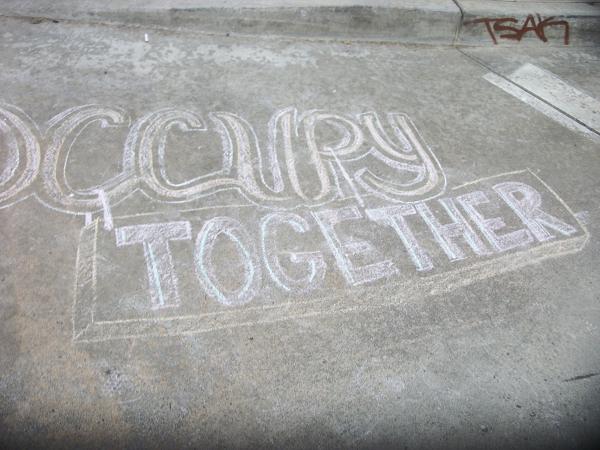
Chalk art

016

Chalk art

017

Chalk art

F29 Walmart Warehouse Shutdown: Victory at Dawn

http://la.indymedia.org/news/2012/03/251808.php

by Rockero Friday, Mar. 02, 2012 at 5:03 PM
rockero420@yahoo.com
Wednesday, February 29, 2011
EASTVALE, California - Nearly 300 people arrived at six in the morning in this desolate inland city with the intent to shut down the world's largest distribution center for Walmart goods. Activists from Occupy Riverside, Occupy LA, other Southern California occupys, community activists, and student groups arrived at the Schneider warehouse only to find that the management had closed the facility of its own accord. Having tasted victory at dawn, the group soon set its sights much higher.
Ever since Occupy Los Angeles called for a general strike on May 1 to counteract the repression of the occupy movement, stand for principles of democracy and liberty, and inspire the working class to recognize its own power, Occupy Riverside has been organizing to make the day, now just two months off, a success.

The buildup strategy unfolds in many ways, but one important part of it is to have large actions every month. January saw the large mobilization in defense of public education at UC Riverside, and the plan to target the Inland Empire's sprawling logistics industry was hatched well before then after occupy activists decided to do something about the labor and human rights abuses rampant in the warehouses in our area.

Many Occupy Riverside activists have worked in the warehouses themselves and know firsthand the plight of the workers, who are processed by temporary agencies like products through a mill. Those who have not been there themselves have family members who work there. And even those of us whose connection to the industry is not as direct must still suffer the impacts of depressed prevailing wages, weak labor protections, and the environmental racism of contamination from the trucks and trains that deliver merchandise from the ports to our warehouses before they are shipped to the rest of the country--mostly by "independent contractor" (that is, non-union) truckers.

After shutting down the ports on December 12, it natural for us to want to do something here, at the next leg of the supply chain. We made contact with labor advocates struggling to organize the warehouse workers and learned that the most egregious abuses were occurring at facilities moving goods for the corporation that is the bane of justice-lovers worldwide: Walmart. After exploring with them how to best keep the workers safe, we proceeded to coordinate with comrades from Occupy LA and elsewhere, who endorsed the action and pledged to participate.

At an early OLA general strike committee meeting, we heard of Occupy Portland's call to shut down the corporations on February 29. "Leap into action" was the tagline for the national day of nonviolent direct action, which focused on the corporations comprising ALEC, the American Legislative Exchange Council.

(ALEC is a consortium of corporations and state legislators that drafts and passes pro-corporate, anti-worker legislation and subsequently "exchanges" it by passing the same or similar laws in other states. The anti-union law signed by Governor Walker of Wisconsin, which prompted the pre-Occupy occupation of the capitol in Madison, was an ALEC brainchild, as was the racist Arizona law SB 1070, which was dreamed up by corporations operating private prisons and detention facilities. Walmart, as the most anti-union force in the world, is a major player in ALEC.)

Workers at the Schneider warehouse were scheduled for dismissal on February 24 for simply speaking up and demanding their rights. The timing and climate was perfect, and the call to action was made.

A court later enjoined Schneider from firing the workers, but that order did nothing to change the desperate conditions of the workers or correct the undemocratic practices of Walmart and ALEC.

So after a rough night of intensive know-your-rights and non-violence training, followed by a campout (complete with camp fire) in the backyard of an Occupy Riverside comrade, the swarm of resilient occupiers arrived. We marched down Hamner, taking the street from the get-go. Our goal was to shut down the warehouse during peak trucking hours, from six until noon. The empty parking lot was a dead giveaway that the warehouse had closed for the day, but we set up a picket line regardless. Not only was there no resistance from the company, but there was none from the police, either. There was not a uniformed officer in sight.

Number of warehouses shut down: 1

Soon, however, we grew impatient. Our researchers had identified another Schneider warehouse just around the corner from the primary target, as well as another nearby Walmart distribution center. As we made moves to create a presence at these secondary targets, our scouts informed us that they were also abandoned, also shut down for the day.

Number of warehouses shut down: 3
We had enough people to secure the non-operation of the first Schneider warehouse, so another group set out southward on Hamner Avenue to blockade the entrance to an Ingraham-Micro warehouse, which moves goods for IBM, Apple, and other high-tech companies who also happen to be ALEC members, where observers spotted trucks entering and exiting and they decided to blockade the entrance there.

Number of warehouses shut down: 4

Soon after the Micro warehouse shutdown, police seemed to be responding by blocking off traffic at a great distance away--as far north as Riverside Drive, and as far South as Cantú-Galleano Road. It was difficult to tell because they were so far away. Regardless, truck traffic was no longer entering the road, effectively shutting down operations at six more warehouses.

Number of warehouses shut down: 10

It was at the Micro entrance that a small conflict arose about what to do about a trucker who wished to exit the grounds. Many people blocked his exit. He explained to them that his container was empty, that he wasn't hauling for Walmart, and that he was an independent contractor who, unlike the unionized UPS truck stuck inside, was not being paid. This persuaded several people who argued that in addition, the action was to prevent the warehouses from profiting from the exploitation of its forklift drivers and order-pullers by preventing the delivery of merchandise, not to prevent the truckers from profiting.

Those in favor of maintaining the blockade argued that the objective was to shut down commerce entirely, not just the warehouses, and that if we let one person go through, where would we draw the line? It took a while, but eventually those in favor of letting him go won out.

By then it had become clear that police were amassing at the ends of road and lining up. But they were still a ways off, so to pass the time, a local alternative rock band came out and played a set.

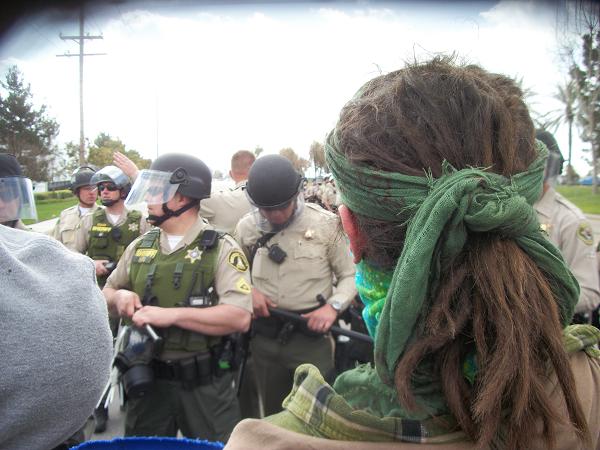
Before they finished, a police line approached the intersection where people were blocking the entrance to the Micro building and asked them to leave. The people held the street and held their ground. After what seemed like an eternity of facing from opposite sides of the intersection, the cops started moving forward. Slowly, maintaining its line, the crowd backed up. The sheriff's deputies barked at us to get back, and futilely ordered us walk up the sidewalk back to the protest.

It took them quite a while to push us down the long and wide street. But by about 11:30, we were already within a hundred yards of the main group at the Schneider and in danger of being surrounded at close quarters. It was then that many people began to enter the grounds of a natural foods company across the street. Earlier, medics had secured permission to use the grounds if anyone needed to be evacuated for medical purposes. But the presence of people on either side of the open gate prevented police from advancing because to do so would have left them exposed on one side.

Eventually the owners herded the occupiers out politely but the move had bought us some time. We were then pushed back to the street of our original picket line and ordered onto it so we could "continue our peaceful protest." When we refused to do so, we were ordered to disperse and began exiting up the sidewalk, which police lined on one side to keep us off the street.

But they did not line the whole street, so after the police line ended, we retook the street. This time the police used a different tactic. We continued to retreat peacefully from their line, moving slowly to ensure everyone's safety. But they became aggressive and hostile. On one side of the line, near the bushes lining the Schneider warehouse parking lot, an officer charged the man in front of him with his truncheon. The deputies on either side of the aggressor likewise rushed out just behind him, in a sort of "V" formation. Some people were thrown into the bushes and likely sustained injury, and some individuals appeared to have been a bit trampled in the melee as well. Two of them were arrested.

Two other charges were made after the same fashion: one towards the middle of the line, and another just afterward, from the side. Officers targetted individuals to jab with their batons, to strike at in the legs, and to grab by the head. At least one pig fell while running and knocked his face shield off.

These rushes caused panic and extremely unsafe conditions but protesters remained as calm as possible and regroup. They condemned the police violence and vowed to return.

As with any action, there are lessons to be learned, but for the most part, the activists expressed satisfaction with the day. Surpassing by tenfold the goal of shutting down the warehouse, successfully remaining nonviolent and working together, holding ground, and never once asking for permission to do any of it from anyone.

Occupy for Prisoners

http://la.indymedia.org/news/2012/02/251636.php

by Rockero Wednesday, Feb. 22, 2012 at 2:43 PM
rockero420@yahoo.com
Monday, February 20, 2012
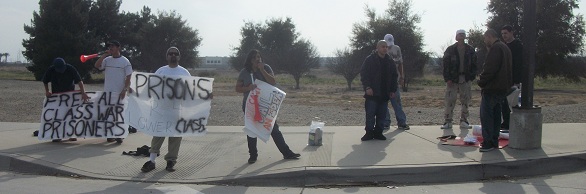
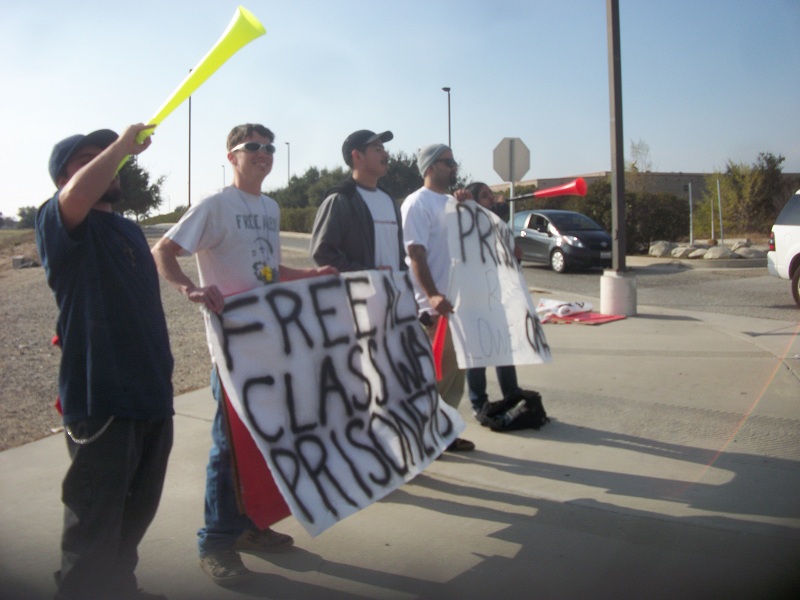
RANCHO CUCAMONGA - Demonstrators from Occupy Riverside and Occupy San Bernardino Valley joined forces to express their solidarity with people detained at West Valley Detention Center, the main detention facility for the western portion of San Bernardino County.
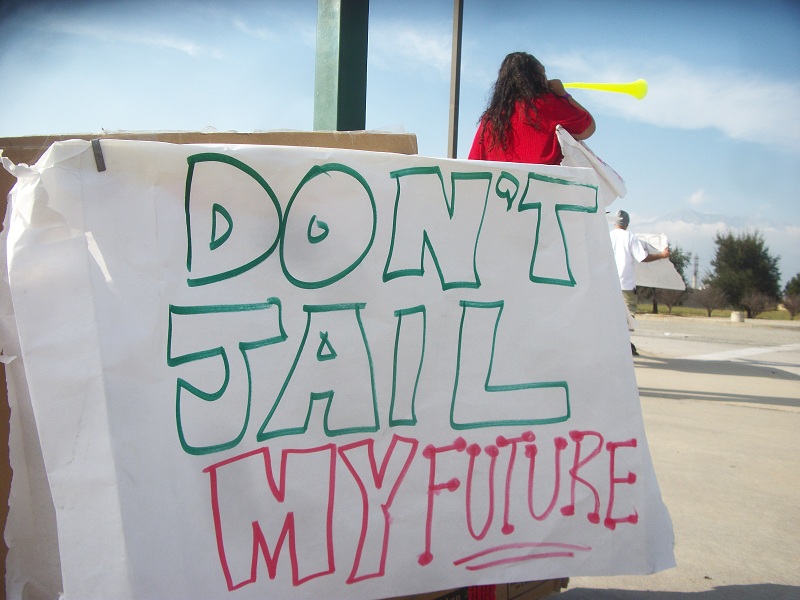
They stood at the main entrance to the jail on Etiwanda street and carried large banners reading "Free All Class War Prisoners," and blew whistles, banged drums, tooted vuvuzelas with the intention of being heard by the people inside.

Some of their chants:

"One, two, three, four! The jails are only for the poor!"

"Banks got bailed, we got jailed!"

"Money for schools, not for jails!"

"Brick by brick, wall by wall! Free the prisoners! Free them all!"

The call for a day of prisoner solidarity came from Pelican Bay, where prisoners have engaged in hunger strikes to end the practice of confining prisoners to solitary confinement "secure housing units" for alleged violations. Other demands included an end to "debriefing," a process by which prisoners are encouraged to inform on other prisoners.

These concerns were echoed by the participants at the protest. Another concern enumerated was the privatization of prisons, which results in the enrichment of corporations and individuals, such as celebrity game show host Bob Barker, at the expense of the jailed, imprisoned, and detained. One such private detention facility opened recently in the high desert city of Adelanto, and is designed specifically to house people detained on suspected immigration violation. Protesters expressed support for longtime political prisoners such as Mumia Abu-Jamal, as well as for the thousands of people who have been unjustly brutalized, arrested, detained, charged, and tried since the beginning of the Occupy movement.

As detainees left their confinement, many were curious about the action and expressed appreciation for the show of solidarity. One young man from Barstow told about being held at the Glen Helen Rehabilitation Center and having been subsequently transferred to West Valley for no apparent reason, with the result being a substantial distance between himself and his support network at home.

Just as the protest was wrapping up, a deputy approached and asked what the protest was about. "We're here because this jail is filled with poor people, while the elites commit much more egregious crimes and yet are walking around free." "I can't argue with that," said the deputy, as he drove off.

002

Freed detainees join the protest.

003

Free All Class War Prisoners!

Monday, February 13, 2012

Cornel West lectures on social justice; PD harasses occupier for flyering

http://la.indymedia.org/news/2012/02/251320.php

by Rockero Wednesday, Feb. 01, 2012 at 10:12 PM 
rockero420@yahoo.com

February 1, 2012
POMONA - The prophetic voice of Cornel West was heard by hundreds of people this evening at Cal Poly Pomona. Dr. West lectured on self-knowledge, what it means to be human, suffering, and the Occupy movement's role in confronting social, civic, and economic death of our society, as well as its moral bankruptcy. The CSUPD, however, sent a different message when its agents silenced an activist by prohibiting him from handing out flyers.
In a talk peppered with the literary and musical references that characterize his speeches, Cornel West dazzled the standing room only audience at the Cal Poly Pomona University​ Theatre. Even the overflow room was standing was nearly overcrowded with hundreds of intrigued attendees, eager to hear Brother Cornel's vision of social justice, articulated through a philisophical, religious, and racial lens.

The mood of the evening changed drastically, however, after then engagement, when a University Police officer approached a man distributing leaflets outside the theater to the crowd. He asked him if he had permission to leaflet, to which the man replied that he hadn't asked for permission. He then proceeded to distribute flyers. The officer became visibly agitated and attempted to snatch the paper from the man's hand. The man resisted, holding onto the flyers, which enraged the officer. The activist let go, explained that he could ask permission, and then informed the officer that he was going to record the interaction.

As soon as the activist turned on the camera, the officer grabbed his wrist and ordered him to set down the camera. He then told the man that he could smell "weed" on him and proceeded to twist the man's arm, forcing him down onto a nearby bench. He continued to twist the arm as he forced the man's torso to the bench. The man vocalized that he wished to comply, and let go of the camera.

The officer took possession of the camera and called for backup. He subsequently searched the man's pockets and backpack, leaving his belongings scattered on the bench. A row of police officers surrounded the scene. By this time, the crowd outside the theater had taken an interest in the affairs. Some among them knew the man in question and vocally objected to the harassment, which further agitated the officer.

The officer accused the man of assaulting an officer, and told him that he was "lucky I didn't use pepper spray." The man was ordered to leave campus immediately. The harassing officer told him he could never return, while the commanding officer told him that if he returned within seven days he would be arrested.

The handbill the activist was distributing was for the Occupy-initiated F29 call to action to shut down the corporations. Occupy Portland called for the movement nationwide to use nonviolent direct action against corporations comprising ALEC, the legislative council that promotes anti-worker and anti-immigrant legislation. Occupy Riverside, heeding the call, selected Walmart as its target, and is supporting un-unionized warehouse workers in their struggle against an impending unjust firing.

Occupy Redlands Protests Citizens United Decision

http://la.indymedia.org/news/2012/01/251217.php

by Rockero Thursday, Jan. 26, 2012 at 2:06 AM
rockero420@yahoo.com
Friday, January 20, 2012
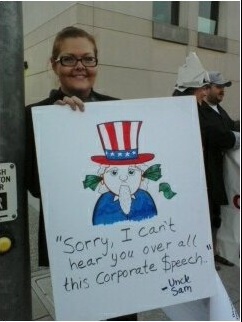
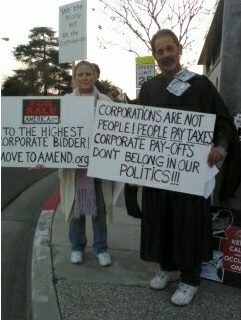
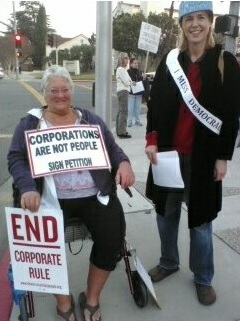
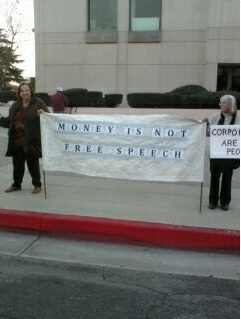
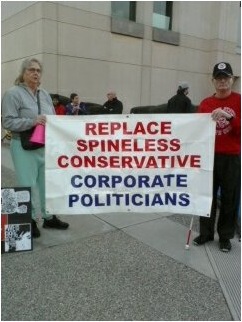
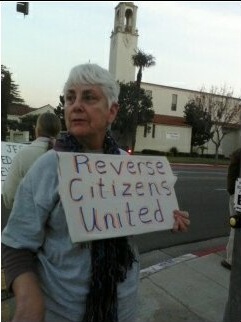
RIVERSIDE (CA) - On the two-year anniversary of the US Supreme Court decision in the Citizens United case, Occupy Redlands staged a protest outside the federal bankruptcy court near downtown Riverside, just a few blocks from the former encampment of Occupy Riverside. Citizens removed limits on corporate campaign contributions to individual candidates, branding the money as "free speech." The ruling, and the sense that it helped to cement that the corporations are in control of the political system, was a strong motivating factor for many middle class people who formerly felt franchised to join the occupy movement. Once supporters from Occupy Riverside arrived, about 30 people were present on the corner outside the court.
Occupy Redlands Prot...
A tent was set up on the corner, and RPD arrived shortly after its erection to repress the protesters. The officer involved insisted that the tent not be set on the ground, so rather than tearing it down, enterprising occupiers simply lifted the tent off the ground, holding it there for the remainder of the protest.

Protest organizers handed out anti-corporate lyrics to song that attendees sang to the tune of Woody Guthrie's "This Land is Your Land." Several people volunteered to perform in a multi-act play about corporate personhood that hearkened back to an imagined time when people held power in this country.

Flyers were handed out for an upcoming action on February 29, and a signature-gatherer circulated a petition to end the death penalty in California.

Some within the Occupy movement support reforms in the political and financial sectors such as the "Move to Amend" the US Constitution to define only natural human beings (to the exclusion of corporations) as "people." Many of us however, while initially motivated to repair perceived flaws in the political structures governing the US, have grown far beyond that position to seek much more than reform.

002

002...

003

003...

004

004...

005

005...

006

006...

007

007...
Holding up tent

008

008...
Legalize democracy